
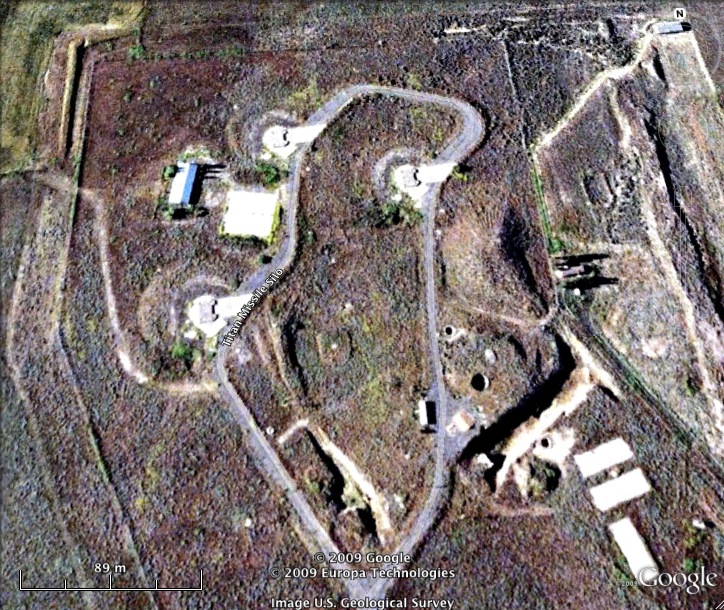
Titan I 568-A Missile Silo Larson AFB Washington
Titan I 568-A
Squadron: 568th SMS
Date Activated: April 1st 1961
Date Deactivated: March 25th 1965
Air Force Base: Larson
State: Washington
Nearest Town: Odessa
Coordinates:
Latitude: 47°11'16.23"N
Longitude: 118°49'18.65"W
Decimal:
Longitude: -118.821847
Latitude: 47 11.2705
Longitude: -118 49.3108333333333
3 silos
Former Titan I Missile Complex with the 568th Strategic Missile Squadron.
This site has been for sale many times on ebay. Not sure what it's current status is.
Read about the Titan I at Larson AFB
List of all Titan I site Coordinates
Detailed information about the Titan I Intercontinental Ballistic Missile can be found here.


Overview
Titan I Missile Complex 568-A was a hardened intercontinental ballistic missile installation built in the rolling agricultural country south of Batum and northeast of Odessa, Washington. Strategic Air Command assigned it to the 568th Strategic Missile Squadron at Larson Air Force Base. The complex contained three launchers and the underground power, control, guidance, propellant, equipment, utility, and personnel spaces needed to place three HGM-25A Titan I missiles on strategic alert. It was one of three complexes in the Larson field. The companion sites were 568-B near Warden and 568-C in the Quincy and Royal City area.The history of 568-A is brief in operational years but exceptionally broad in subject. Its construction joined one of the largest engineering programs of the early Cold War. Its crews served during the Cuban Missile Crisis. Its liquid-fueled weapon and radio-guidance system marked a transitional stage between the first Atlas force and later silo-launched solid-fueled missiles. After deactivation, the Air Force removed missiles and much support equipment, transferred the property for federal disposal, and left a vast underground plant whose reuse was difficult and whose environmental obligations continued for decades.
Evidence must be separated carefully. Official histories provide precise milestones for the Larson field and the 568th Squadron, but they rarely identify which one of the three complexes reached an intermediate milestone first. A 1962 Air Force Magazine photograph documents Titan Base T-4 activation work in the Larson field but does not identify 568-A, 568-B, or 568-C. A National Park Service inventory identifies the Odessa site and its three launchers, while modern federal and Washington records identify the Batum property through FUDS and Cleanup Site 1730. This history applies field-wide facts only at field scale and labels standard Titan I engineering as representative rather than a surveyed 568-A plan.

Installation Identity, Location, and Boundaries
Several names refer to the same installation. The Air Force designation 568-A combines the 568th Strategic Missile Squadron number with its A complex. Engineering histories also call it Larson Site 1, Complex 1A, the Odessa site, or Larson AFB Missile Facility S-1. Federal environmental records use FUDS property F10WA0349 and federal facility identifier WA09799F331800. Washington Ecology calls the cleanup property WWT Batum Facility and assigns Cleanup Site ID 1730 and Facility Site ID 560. These are military, geographic, property, and regulatory aliases for the same former Titan complex, not separate installations.The site belongs in Adams County. Some later newspaper language placed it in Grant County, probably because Larson Air Force Base, Moses Lake, and much of the supporting network were in Grant County. Current Washington Ecology and federal FUDS records identify the Batum property in Adams County.
The representative coordinate is 47.187842 north latitude and -118.821847 west longitude. It agrees closely with independent public mapping of the former complex and is consistent with Ecology's address description, Batum Road 3.25 miles south of Batum. The Ecology map view centers farther north because its side panel changes the displayed map center; that URL center is not treated as a surveyed feature point. The retained coordinate identifies the installation at general-complex scale only. It does not identify an entrance, silo, legal parcel corner, contamination sample, safe approach, or permitted access route.
The only acreage found in site-specific public reporting is an owner-provided estimate of roughly 57 acres during a 2007 sale effort. That figure is useful for describing the marketed property but cannot be assumed to equal the original Air Force acquisition or the present tax parcel. Missile properties commonly included fee land, access rights, utility interests, and later subdivisions. No current deed, assessor map, or federal acquisition schedule was located that safely reconciles those categories for 568-A.
The Batum and Odessa Landscape
The complex occupied open agricultural country in eastern Washington, separated from Larson Air Force Base and from the other launcher groups by many miles. Open terrain reduced nearby population exposure and allowed the three Larson complexes to be dispersed so that one attack would be less likely to destroy all nine launchers. The location also created logistical burdens. Crews, security forces, maintenance specialists, spare parts, test equipment, food, fuel, and emergency support had to move between Larson and remote installations in a region of seasonal heat, winter cold, wind, dust, and long road distances.The Batum label reflects a small rural locality and rail-oriented landscape, while Odessa was the larger community commonly used to describe the site. Neither name means that the missile complex was a town installation. It was a fenced federal weapons facility placed in farm country. Later private ownership did not erase the physical distinction between surrounding agricultural land and the specialized underground plant.
The selection also tied the complex to Larson's runway, logistics, communications, command, housing, and maintenance resources. The missile site generated its own emergency power and could sustain alert operations underground, but it was not an independent base. Its squadron headquarters, wing command, supply system, personnel administration, and much of its technical support remained at Larson.
Titan I emerged from the American effort to place a dependable intercontinental ballistic missile force on alert before the Soviet Union could gain a decisive strategic advantage. The Air Force developed Titan alongside Atlas so that a major failure in one program would not leave the country without an ICBM. Titan used a rigid, load-bearing airframe and two liquid-propellant stages. Its long range, nuclear payload, and rapid flight time changed strategic planning by allowing distant targets to be threatened within about half an hour, but the first version still required substantial ground machinery and preparation before launch.
Survivability drove the move underground. A surface launch pad, exposed control building, and visible fuel plant were vulnerable to attack, sabotage, and weather. The Titan I complex placed its missiles, crew, communications, power, guidance, and propellant-support equipment in reinforced structures linked by flexible tunnels and isolated with blast doors. Dispersing three complexes across each squadron field further reduced the chance that one enemy weapon could disable all nine launchers. This architecture made 725-C a hardened combat installation rather than a simple storage site.
Titan I nevertheless retained major first-generation limitations. RP-1 kerosene could be stored, but cryogenic liquid oxygen could not remain indefinitely aboard the missile. Before launch, crews had to load oxidizer, complete system checks, open the silo doors, elevate the fueled missile above ground, and raise a guidance antenna. The missile then depended on ground radio guidance during early flight. Titan II and Minuteman eliminated much of this vulnerability through storable propellants or solid fuel, launch-from-silo operation, and improved guidance. Complex 725-C is valuable precisely because it preserves the transition between exposed launch pads and later self-contained silos.
The Larson T-4 Field
The Larson program was known as Titan Base T-4. The Army Corps of Engineers opened a Larson area office in October 1959 to administer nine silos at three dispersed sites and supporting work at Larson Air Force Base. Oversight transferred to the Corps of Engineers Ballistic Missile Construction Office in October 1960 as the national missile program centralized schedule, engineering, and contractor control.The three complexes were organized as three-launcher units. 568-A served the Batum and Odessa sector, 568-B the Warden sector, and 568-C the Quincy and Royal City sector. Together they provided nine launchers for the 568th Strategic Missile Squadron. This arrangement spread the weapon system across a broad field while preserving common squadron training, communications, maintenance, and command relationships.
Larson's Titan force was only one element of the base's larger Cold War mission. The 4170th Strategic Wing initially supported the missile squadron, and the 462d Strategic Aerospace Wing assumed the relationship on February 1, 1963. Aircraft and missile missions therefore shared the parent installation but used very different operating environments. The launch complexes were remote nuclear installations whose hardened underground machinery, strict authentication procedures, and continuous alert posture differed sharply from ordinary airfield operations.
Design, Contracting, and Construction
Bid packages for the Larson complexes opened on November 18, 1959. The low bid, approximately $31.6 million for the principal field construction, came from a joint venture of MacDonald Construction Company, The Scott Company, Paul Hardeman, G. H. Leavell, F. E. Young, and Morrison-Knudsen. The figure covered the group program rather than 568-A alone. Later contracts supplied specialized systems, including propellant-loading equipment, and the final field cost necessarily extended beyond the initial construction bid.

Water was a major Larson-field problem. By August 1961 one of the three sites was pumping approximately 175,000 gallons a day. The source does not identify which complex experienced that rate, so the figure cannot be assigned specifically to 568-A. Improved drainage reduced the problem at field scale. The episode nevertheless shows why drainage galleries, pumps, sumps, waterproofing, and groundwater control were vital to an installation whose most important spaces lay far below grade.
The Larson project recorded no worker deaths, but its initial lost-time accident rate was about twice the national average for comparable construction. The program added a full-time safety engineer, and the rate later fell below the comparable average. These field-wide facts describe the pressure and risk of a fast missile-building program without inventing a site-specific accident record for 568-A.
The rapid schedule also created a moving technical target. Titan I was still being developed while operational sites were built. Changes in missile equipment, blast criteria, elevators, doors, guidance, communications, propellant handling, safety interlocks, and acceptance tests could force rework. Concrete completion therefore did not equal combat readiness. The finished structures had to receive government-furnished equipment, missile-support machinery, command systems, and trained crews before acceptance.
Standard Underground Design and Surface Layout
No complete site-specific measured drawing of 568-A was located. Its documented three-launcher role and membership in the standardized Larson field permit the use of established Titan I engineering as a strong analogue, but not as a claim that every dimension or later alteration at Batum matched another surveyed complex. The accompanying layout graphic is therefore labeled representative standard configuration and not a 568-A as-built survey.

Three launcher branches extended from the central area. Each branch incorporated an equipment terminal, a propellant terminal, connecting tunnels, and a missile silo. The equipment terminal supported the launcher elevator and associated machinery. The propellant terminal handled RP-1 kerosene fuel and liquid oxygen equipment. The silo contained the missile on a large elevator beneath paired doors. Titan I could not launch from inside the silo. It had to be fueled, raised into the open, and fired from the surface.
Two retractable guidance antennas occupied protected antenna silos. Titan I carried inertial instruments but relied on radio corrections transmitted from the ground during early flight. Redundant antennas reduced the risk that a single failure would prevent guidance support. Their presence explains why a Titan I complex contained multiple large shafts in addition to the three missile silos.
Surface features included security fencing, access and patrol roads, launcher doors, antenna doors, vents, hatches, utility structures, orientation and survey features, drainage works, and support areas. Salvage, private reuse, weather, standing water, and environmental investigation may have changed many of those elements. Historic design cannot establish current structural condition.
The HGM-25A Titan I was a two-stage liquid-propellant missile approximately 98 feet long. Both stages burned RP-1 kerosene and liquid oxygen. A nuclear reentry vehicle gave the missile its strategic effect, while engines, airframe, inertial components, radio guidance, communications, and launch equipment came from a national contractor network. At 725-C, these elements operated as one system. The missile could not fulfill its mission without the site's power, oxidizer plant, elevators, doors, antennas, crew, and authenticated command link.
Liquid oxygen governed readiness. Its extremely low temperature and continual boil-off prevented long-term storage aboard the missile, so the launch sequence included oxidizer loading. Crews treated oxygen equipment as surgically clean because oil, dirt, or incompatible material could cause fire or explosion. HAER interviews describe cleanliness standards below 150 microns, pressurized clean rooms, vapor degreasing, caustic cleaning, black-light inspection, and repeated checks. Liquid nitrogen, high-pressure nitrogen and helium, diesel fuel, hydraulic fluid, lubricants, batteries, and other industrial materials added more hazards.
Propellant Loading Exercises tested every missile on a roughly 90-day cycle, which meant approximately one exercise each month at a three-launcher complex. The procedure forced operations and maintenance personnel to verify tanks, pumps, lines, valves, sensors, timing, and emergency actions under conditions approaching a real countdown. These exercises were essential because Titan I's deterrent value depended on machinery that normally remained idle. They also placed sustained demands on the environmental, safety, and waste-handling systems later examined during cleanup.
A launch order required authenticated messages and controlled cooperation by trained crew members. Once the sequence began, the system loaded liquid oxygen, checked missile and site status, opened the selected silo doors, raised the missile on its elevator, deployed a guidance antenna, and completed ignition preparations. The three missiles could be launched in sequence. Titan I was dramatically faster than an aircraft-delivered weapon, but the fueling and elevation process left it more exposed and slower to respond than the later Titan II and Minuteman systems that launched directly from closed, fueled or solid-propellant silos.
Site Activation and Acceptance
The Corps of Engineers turned the three completed Larson complexes to the Site Activation Task Force on March 16, 1962. Titan missiles had begun arriving from Denver on January 23. Activation teams installed, checked, calibrated, and exercised systems that construction contractors had placed in the underground plants. Federal Electric Corporation, a service associate of International Telephone and Telegraph, supported Martin with installation and testing of missiles and ground equipment, interim operation, contractor support, and turnover assistance.A contemporary Air Force Magazine advertisement photographed a Larson Titan Base T-4 activation scene. It is valuable because it shows real equipment and personnel from the correct missile field in 1962. The caption does not name a particular complex, so this history does not present it as a photograph of 568-A. It documents the shared activation program at Larson and illustrates the contractor-intensive transition from construction to Air Force control.

Organization and the 568TH Strategic Missile Squadron
The Air Force redesignated and activated the 568th Strategic Missile Squadron on October 24, 1960 and organized it at Larson on April 1, 1961. The squadron was initially assigned to the 4170th Strategic Wing. It transferred to the 462d Strategic Aerospace Wing on February 1, 1963. Its weapon system was the SM-68, later designated HGM-25A, Titan I.The squadron operated all three complexes as one combat organization. A particular alert crew worked at an individual site, while squadron leaders, maintenance organizations, security forces, communications systems, and parent-wing resources connected the entire field. Nine launchers did not mean nine independent commands. The complexes had local control and self-contained support, but authenticated orders and readiness accountability flowed through Strategic Air Command.
Personnel required recurring training in console operations, emergency procedures, propellant safety, electrical and hydraulic systems, communications, security, and nuclear command and control. Maintenance specialists had to understand how a defect in one subsystem affected the whole launch sequence. The early missile force depended on skilled human monitoring because many functions that later became automated still required extensive testing, alignment, servicing, and procedural control.
Alert Operations
Alert duty combined routine checks with readiness for an event of extraordinary consequence. Crews monitored status lights, communications, environmental controls, electrical systems, security reports, and missile condition. They maintained logs, ran prescribed tests, and followed two-person control procedures. Security forces controlled entry and patrolled the surface, while maintenance teams responded to equipment discrepancies without compromising nuclear surety.The underground complex was designed to continue functioning after outside utilities failed. Diesel generation, stored supplies, filtered ventilation, protected communications, and hardened access supported survivability. Hardening did not make the installation invulnerable. Its dispersal, burial, blast-resistant construction, redundancy, and rapid launch sequence together sought to preserve retaliatory capability long enough to deter attack.
Titan I's cryogenic design placed a special burden on alert operations. Liquid oxygen could not remain indefinitely in the missile. A launch order would initiate a controlled sequence involving authentication, system checks, propellant loading, guidance preparation, silo-door operation, elevator movement, and surface launch. The need to raise the missile left the weapon exposed during the final sequence, one reason later Titan II and Minuteman systems emphasized in-silo launch and more readily stored propellants.
The radio-guidance system linked the missile to protected ground antennas. Inertial instruments provided basic navigation, while ground equipment calculated and transmitted corrections during early flight. That arrangement demanded reliable electronics, precise surveying, communication among subsystems, and functioning antenna machinery. Guidance was not an accessory. It was part of the operational weapon system.
The Cuban Missile Crisis
The squadron reached operational status just weeks before the Cuban Missile Crisis of October 1962. The timing placed the new Larson force on alert during the most dangerous confrontation of the Cold War. Official sources establish the squadron's operational status and the national alert environment, but the records reviewed do not provide a surviving 568-A crew log or a site-specific narrative of those days.The significance therefore lies in confirmed readiness rather than invented drama. Men at Batum maintained a live intercontinental ballistic missile installation while national command authorities confronted Soviet missile deployment in Cuba. Communications, authentication, security, mechanical reliability, and disciplined adherence to procedure all carried immediate strategic importance. The site's purpose was deterrence, and the crisis tested whether that deterrent could be presented as credible without being used.
Communications, Guidance, Power, Security, and Maintenance
Reliable communications connected the remote complex to squadron and Strategic Air Command channels. Emergency Action Messages required authentication and controlled handling. Two-person procedures reduced the possibility that one individual could initiate critical actions. Exact equipment complements changed during construction and service, and no complete 568-A communications inventory was located, so standard Titan I functions are described without assigning an unsupported model number to every rack or circuit.The powerhouse served as the site's mechanical heart. Multiple diesel generators, switchgear, batteries, hydraulic equipment, ventilation, pumps, and cooling systems allowed the complex to support missile readiness independent of ordinary utilities. Machinery also created maintenance demands and potential environmental sources. Fuels, lubricants, solvents, electrical components, sumps, drains, and wastewater systems later became part of the broader environmental inquiry at former missile sites.
Security began with remoteness, fencing, controlled gates, alarms, patrols, identification procedures, and armed response. It continued underground through protected portals and controlled areas. Modern private ownership and the visibility of large surface doors do not erase those historic layers, but neither do they make the site safe to enter. Deep shafts, decayed floors, unguarded openings, poor air, standing water, electrical remnants, and contaminated media can turn curiosity into a fatal hazard.
Maintenance was continuous because Titan I combined cryogenic propellant systems, high-pressure gases, mechanical elevators, heavy doors, guidance electronics, power generation, ventilation, and early command equipment. A failure in one component could remove a launcher from alert. Preventive maintenance, periodic tests, parts supply, contractor support, and disciplined documentation were as essential to readiness as the missile itself.
Phaseout and Deactivation
Titan I entered service as a first-generation operational ICBM and was overtaken quickly by systems that could remain fueled, launch from within a silo, and operate with fewer people. In May 1964 the national phaseout schedule accelerated. The short lifespan did not make the Larson investment meaningless. Titan I trained organizations, crews, engineers, and contractors in dispersed ICBM operations and helped establish the procedures used by later forces.The 568th removed its first missile from alert on January 4, 1965 and its last on February 2. The last missile left the squadron on February 8, and the unit inactivated March 25. Those milestones are squadron-wide. Available sources do not identify the exact day each individual 568-A launcher left alert or the order in which the three complexes were emptied.
After deactivation, missiles went to Norton Air Force Base and contractors removed much aerospace ground equipment, including diesel generators. The sites passed to the General Services Administration for open-market disposal. Equipment removal and salvage did not eliminate the reinforced shafts, tunnels, terminals, and major concrete structures. The government was disposing of specialized real property whose underground volume and hazards made ordinary redevelopment difficult.
Disposal, Salvage, and Private Ownership
A National Park Service inventory described the Odessa site as privately owned, with materials salvaged and the principal structure remaining intact at the time of that study. The wording should not be read as a current engineering inspection. It establishes the general post-military path: disposal into private ownership, recovery of valuable equipment and materials, and survival of a large buried shell.In 2007 owner Bari Hotchkiss offered the property for sale through an online auction listing with an asking price of $1.5 million. Newspaper reporting described roughly 57 acres, sixteen underground buildings, three missile silos about 160 feet deep, three four-story equipment terminals, two antenna silos, and large control and power domes. These dimensions and counts came through the owner and news account, not a new federal survey, but they communicate the extraordinary scale of the property.
Hotchkiss said he had owned the site for about a decade after acquiring it from a partnership that had bought it from the government. He envisioned educational or youth-oriented reuse. The reporting documented an aspiration, not a completed conversion. No authoritative evidence reviewed establishes that the proposal was implemented or that the 2007 owner still holds title in 2026.
The same reporting emphasized that visits required permission and that falls posed a severe danger. That warning remains historically important even though current conditions were not inspected. Abandoned missile complexes may contain open shafts, corroded ladders, unstable railings, flooded levels, confined spaces, biological hazards, and residues. Neither photographs nor a representative coordinate can substitute for owner authorization and professional safety evaluation.
Environmental Registration and Response
The Department of Defense identifies the former property as FUDS F10WA0349, federal facility identifier WA09799F331800. A 2015 Army Corps Washington inventory lists two projects: Project 01 for Hazardous, Toxic, and Radioactive Waste work and Project 02 for Containerized Hazardous and Toxic Waste. The federal inventory places the property at Batum in Adams County and assigns it to the Northwestern Division and Kansas City District restoration structure.Government Accountability Office reporting from 2001 showed Project 01 in remedial investigation and feasibility study with a medium relative risk designation. Project 02 was in remedial design. The historical table reported $189,000 incurred and $568,000 estimated for Project 01, plus $108,000 estimated for Project 02. An aggregate property page reported slightly different totals, illustrating why dated cost tables should be treated as snapshots rather than current budgets.
Department of Defense fiscal-year 2023 reporting listed two Installation Restoration Program sites and no Military Munitions Response Program sites for the property. It showed $234,000 in IRP costs through fiscal year 2021 and an estimated $462,000 from fiscal year 2022 through completion. The projected final response complete year was fiscal year 2032. A projection is a planning milestone, not evidence that investigation, cleanup, controls, or monitoring have already ended.
Washington Ecology maintains a separate current cleanup record under WWT Batum Facility, Cleanup Site 1730. The page identifies Facility Site ID 560, Adams County, and an address description of Batum Road 3.25 miles south of Batum. Its current status is Awaiting Cleanup and its process type is Independent. The earliest recorded date is September 20, 1984. The current page lists suspected petroleum products and unspecified pesticides in soil and cautions that contaminant lists may not reflect present conditions.
An older state Hazardous Sites List shows that the facility entered the list on February 15, 1991 with rank 5 and source categories Military Facilities and Munitions Related. The current Ecology page has no linked cleanup documents. That absence does not mean no work occurred; it means the public site profile does not presently provide the detailed reports needed to reconstruct sampling locations, concentrations, remedies, or boundaries.
Federal and state records therefore answer different questions. FUDS identifies former Department of Defense responsibility and project status. Ecology records the state cleanup site and suspected media. Neither record establishes a safe underground condition, a public access right, a current parcel owner, or the exact boundary of affected soil. No plume map or current sampling dataset was located, so the environmental graphic avoids drawing one.
Surviving Features and Current Status
Historic descriptions show that large underground features survived disposal and salvage, and the 2007 sale account documented extensive accessible spaces at that time. Those sources cannot establish 2026 structural integrity. Concrete can remain while stairs, platforms, utilities, doors, seals, and ventilation deteriorate. Water intrusion can accelerate corrosion and conceal hazards. A structure may be physically present without being usable or safe.Current Washington Ecology status is Awaiting Cleanup. Department of Defense records still show two open restoration projects with a projected fiscal-year 2032 final response milestone. Exact private ownership and day-to-day property use were not verified through a current deed or owner statement.
Public access is not established. The 2007 owner required permission, and no later authoritative source reviewed grants general visitation. The complex is not a public museum. Any legitimate inspection would require current owner consent, compliance with environmental and land-use controls, and professionals able to manage shafts, confined spaces, air quality, water, structural decay, and fall protection.

Detailed Chronology
- 1955 The Air Force selected Martin's Titan proposal as a second intercontinental ballistic missile program.
- 1958 National planning moved Titan I toward dispersed hardened operational deployment.
- October 1959 The Army Corps of Engineers opened its Larson area office for the T-4 field.
- November 18, 1959 Larson field construction bids were opened.
- December 1, 1959 Principal field construction began.
- October 1960 Construction oversight transferred to the Corps of Engineers Ballistic Missile Construction Office.
- October 24, 1960 The Air Force redesignated and activated the 568th Strategic Missile Squadron.
- April 1, 1961 The 568th Squadron was organized at Larson Air Force Base under the 4170th Strategic Wing.
- August 1961 One unidentified Larson site was pumping about 175,000 gallons of water per day; improved drainage later eased the field problem.
- January 23, 1962 Titan missiles began arriving at Larson from Denver.
- March 16, 1962 The Corps turned the three Larson complexes to the Site Activation Task Force.
- April 1962 Air Force Magazine documented Federal Electric Corporation activation work at Larson Titan Base T-4.
- July 16, 1962 The first Larson complex was declared operational; the source does not identify which complex.
- September 26, 1962 Official Air Force and unit-history records mark squadron turnover and operational status.
- September 28, 1962 Headquarters Strategic Air Command declared the 568th Squadron operational according to SAC chronology.
- October 1962 The operational Larson Titan force stood alert during the Cuban Missile Crisis.
- February 1, 1963 The 568th Squadron was assigned to the 462d Strategic Aerospace Wing.
- May 1964 The national Titan I phaseout schedule accelerated.
- January 4, 1965 The first 568th Squadron missile came off alert.
- February 2, 1965 The last 568th Squadron missile came off alert.
- February 8, 1965 The last squadron missile was shipped from the Larson field.
- March 25, 1965 The 568th Strategic Missile Squadron was inactivated.
- 1965 and after Missiles went to Norton Air Force Base, much ground equipment was removed, and the sites entered General Services Administration disposal.
- Post-1965 568-A passed into private ownership and underwent material salvage.
- September 20, 1984 Washington Ecology's current record gives its earliest recorded cleanup-site date.
- February 15, 1991 The Batum facility entered the Washington Hazardous Sites List with rank 5.
- By approximately 1997 The owner identified in 2007 reporting had acquired the property from an earlier private partnership.
- September and October 2007 Newspaper accounts described Complex 1A and its online sale offering at an asking price of $1.5 million.
- 2015 The Army Corps Washington FUDS inventory listed two restoration projects at the Batum property.
- Fiscal year 2023 Department of Defense reporting showed two IRP sites, no MMRP sites, and projected final response complete in fiscal year 2032.


Sources & References
- PDF National Park Service and Department of Defense, To Defend and Deter: The Legacy of the United States Cold War Missile Program Used for: Larson T-4 contracting, construction, water, safety, operational chronology, phaseout, disposal, and site inventory.
- PDF Air Force Historical Research Agency, 568th Strategic Missile Squadron lineage and history Used for: Activation, organization, assignments, Titan I weapon system, turnover, operational, alert-withdrawal, shipment, and inactivation dates.
- PDF Office of Air Force History, Ballistic Missiles in the United States Air Force, 1945-1960 Used for: Official Air Force program context and 568th Squadron milestone crosscheck.
- PDF Strategic Air Command, Missile Chronology 1939-1988 Used for: Headquarters SAC operational declaration of September 28, 1962 and broader missile-force chronology.
- PDF Air Force Magazine, April 1962, Titan Base T-4 activation advertisement Used for: Contemporary Larson-field activation photograph and Federal Electric Corporation support role.
- WEB National Park Service, Titan Intercontinental Ballistic Missile Used for: Standard Titan I underground configuration, weapon operation, launch sequence, and program interpretation.
- WEB National Museum of the United States Air Force, Martin Marietta SM-68A/HGM-25A Titan I Used for: Missile designation, propulsion, dimensions, performance context, and operational history.
- WEB Association of Air Force Missileers, Titan I Used for: Standard three-by-three squadron configuration, underground operating concept, and alert-force context.
- PDF U.S. Army Corps of Engineers, Washington Formerly Used Defense Sites inventory Used for: FUDS property F10WA0349, Batum and Adams County identity, federal facility identifier, two project records, and organizational routing.
- PDF Department of Defense, fiscal-year 2023 restoration status table for properties with cost to complete at or below $10 million Used for: Two IRP sites, no MMRP sites, reported costs, and projected fiscal-year 2032 final response complete.
- WEB U.S. Government Accountability Office, FUDS cleanup project status for Washington Used for: 2001 project phases, relative risk, incurred costs, estimates, and historical restoration status.
- WEB Washington State Department of Ecology, WWT Batum Facility Cleanup Site 1730 Used for: Current Awaiting Cleanup status, independent process, address, county, earliest record date, and suspected soil contaminants.
- PDF Washington State Department of Ecology, Hazardous Sites List Used for: State cleanup-list context and verification of WWT Batum Facility listing.
- PDF Washington State Department of Ecology, legacy Hazardous Sites List report Used for: February 15, 1991 listing date, rank 5, and military and munitions source categories.
- WEB Columbia Basin Herald, Titan missile complex for sale Used for: Complex 1A identity, 2007 owner, asking price, owner-reported acreage, underground feature description, proposed reuse, and access warning.
- WEB The Spokesman-Review, Missile site up for sale Used for: 2007 sale context and private ownership chain, with its Grant County wording rejected in favor of government Adams County records.
- WEB Library of Congress, Historic American Engineering Record CO-89 Titan One Missile Complex 2A Used for: Standard Titan I engineering analogue, construction process, layout, launcher, control, power, antenna, and guidance functions. It is not a 568-A survey.