
Titan I 569-A Missile Silo Mountain Home AFB Idaho
Titan I 569-A
Squadron: 569th SMS
Date Activated: June 1st 1961
Date Deactivated: June 25th 1965
Air Force Base: Mountain Home
State: Idaho
Nearest Town: Bruneau
Coordinates:
Latitude: 42°40'13.10"N
Longitude: 115°52'2.96"W
Decimal:
Longitude: -115.867489
Latitude: 42 40.2183333333333
Longitude: -115 52.0493333333333
3 silos
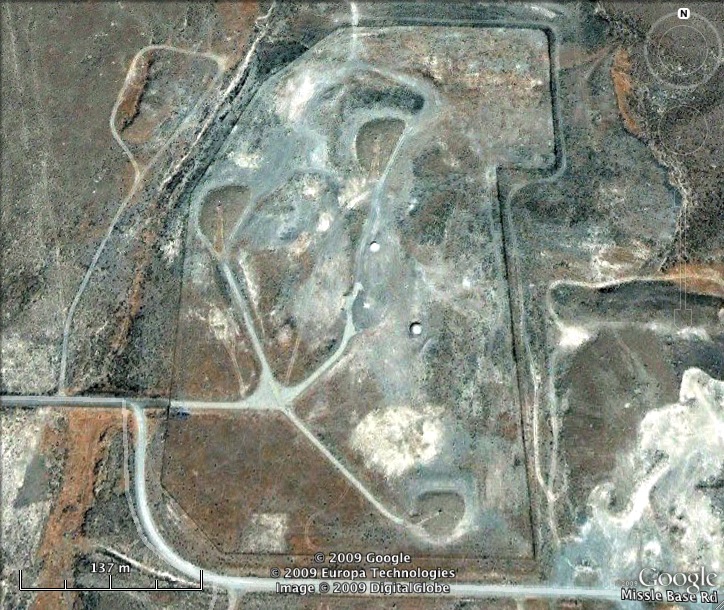
Former Titan I Missile Complex with the 569th Strategic Missile Squadron. All of the above ground structures were demolished and the site was being used as a hazardous waste storage facility.
Read about the Titan I at Mountain Home AFB
List of all Titan I site Coordinates
Detailed information about the Titan I Intercontinental Ballistic Missile can be found here.


Overview
Titan I Missile Complex 569-A was the southern launch complex in the three-site Titan I field controlled by the 569th Strategic Missile Squadron at Mountain Home Air Force Base. The complex stood in Owyhee County, about 18 miles south of Bruneau, amid the semiarid sagebrush and open range east of Idaho Highway 51. Three HGM-25A Titan I missiles, their underground launchers, control center, powerhouse, guidance antenna silos, propellant terminals, equipment terminals, utilities, security works, and crew spaces formed one-third of Mountain Home's nine-launcher missile force.The installation is exceptional because its postmilitary use is documented almost as extensively as its missile role. Federal disposal and salvage were followed by private industrial use of the underground structures. Wes-Con began receiving wastes about 1973. Envirosafe Services of Idaho acquired the property in 1981 and continued disposal until January 1983. Idaho records identify the later facility as U.S. Ecology of Idaho Site A, EPA ID IDD000773952.

The closed facility is not an abandoned, visitable missile ruin. The 2017 Idaho Department of Environmental Quality permit identifies regulated units as closed landfills and requires post-closure care, monitoring, security, cover maintenance, and reporting. The six-foot chain-link perimeter fence, barbed wire, locked gates, warning signs, caps, drainage works, and monitoring wells are part of an environmental-control system. Historic curiosity does not create permission to enter.
The permit application also preserves unusually detailed measurements and reuse evidence. It describes approximately 82.5 acres under U.S. Ecology ownership incorporating a roughly 30-acre missile base, 157-foot-deep missile silos, 40-to-60-foot-deep connecting tunnels, two former antenna shafts, and the sequence of waste filling, cleanup, capping, and regrading. Those records allow this history to distinguish the military installation, the later hazardous waste facility, and the surrounding federal open range.
Installation Identity, Location, and Boundaries
Its parent is Mountain Home Air Force Base. Military sources use 569-A, Site 1, Site A, and Bruneau. Environmental sources use U.S. Ecology of Idaho Site A and EPA ID IDD000773952. These names describe the same physical complex at different points in its history.The permit application places the facility approximately 18 miles south of Bruneau and about two miles east of Highway 51 on Missile Base Road. It identifies Owyhee County, not Elmore County, for the former launch complex. Mountain Home Air Force Base itself lies in Elmore County, so the parent installation and remote missile site must not be assigned the same county merely because they belonged to one military system.
The reviewed permit application reports that U.S. Ecology owned approximately 82.5 acres incorporating a 30-acre missile base. All land within 1,000 feet of the facility boundary was described as federal property managed by the Bureau of Land Management as open range. The 82.5-acre figure belongs to the later permitted property. It does not prove the original federal acquisition, operational fence line, or current title outside the permit record.
The military complex and hazardous waste facility overlap physically but are not interchangeable legal descriptions. The original site included buried launch and support structures plus surface support works. The later regulated property defined closed waste units, caps, wells, fences, gates, drainage controls, and inspection duties.
The Bruneau Landscape
Complex 569-A occupied semiarid high desert and open range south of Bruneau. The permit application describes native grasses, shrubs, and sagebrush, approximately eight inches of annual precipitation, and much higher potential evapotranspiration. The ground slopes gently north with roughly 50 feet of relief across the 2,000-foot north-to-south property dimension.The sparse landscape suited Strategic Air Command's need to separate launch complexes from the parent base and from one another. Dispersal reduced the possibility that one attack could destroy every missile assigned to the squadron. It also forced crews, security personnel, maintainers, contractors, and supplies to travel long rural routes between Mountain Home AFB and the three sites.
Water supply was a major construction issue despite the dry surface climate. Mountain Home's official history reports wells ranging from about 950 to 3,030 feet and requiring special filtration. Later environmental regulation focused on a different water problem: protecting and monitoring groundwater beneath a former industrial disposal facility. The two water histories must not be confused.
The nearest perennial surface waters identified in the permit application are the Bruneau River, about 11 miles away, and Big Jacks Creek, about seven miles away. An intermittent drainage lies west of the property. Engineering review found the waste-management units outside the evaluated 100-year flood area, while diversion channels and berms route upslope runoff around the capped units.
The surrounding federal land was described as Bureau of Land Management open range with occasional livestock grazing. The regulated facility itself is secured and restricted. Open-range conditions outside the fence do not imply access to the former missile property or permission to disturb caps, wells, roads, signs, or buried structures.
The Mountain Home Titan I Field
Mountain Home supported three standardized three-launcher Titan I complexes: 569-A near Bruneau, 569-B near Oreana, and 569-C near Orchard and Boise. Together they provided nine launchers for the 569th Strategic Missile Squadron. The arrangement joined remote hardened sites to one parent base for command, maintenance, security, training, housing, logistics, and administration.
The 9th Bombardment Wing provided the parent organization when the missile mission arrived. To reflect its combined bomber, tanker, and missile responsibilities, the Air Force redesignated it the 9th Strategic Aerospace Wing in April 1962. Mountain Home's B-47 and KC-97 alert operations continued while the new underground missile field entered service.
The 569th was the last Titan I squadron activated by Strategic Air Command. Its late place in the deployment sequence gave it only a short operational life before national policy moved toward Titan II and Minuteman. The site still carried a full nuclear-alert mission during a critical Cold War period, including the Cuban Missile Crisis.
Official Mountain Home history reports that the three-site program began with an initial construction cost of $28.9 million and grew beyond $51 million because of labor shortages, material shipping costs, severe weather, and extensive design changes. Those are field-wide totals and causes, not a cost assigned to 569-A alone.
Design, Contracting, and Construction
Construction of the three Mountain Home complexes began in 1960 after late-1950s site assessments. The official base history states that work finished before the April 1, 1962 deadline despite extreme weather, material-shipping problems, labor shortages, design changes, and strikes. The Idaho program recorded three worker deaths. The reviewed source does not allocate those accidents to a particular complex, so they are field-wide facts.The Mountain Home sites used the same cut-and-fill principle as other operational Titan I complexes. Contractors excavated large open pits, constructed reinforced concrete and structural-steel facilities, installed heavy machinery and utility systems, and then backfilled until only doors, hatches, vents, roads, security works, and limited support structures remained visible.

The Bruneau permit application provides rare site-specific dimensions. It describes three missile silos about 44 feet in diameter and 157 feet deep. Each launcher branch had adjoining liquid-oxygen propellant, equipment, and exhaust terminals. The liquid-oxygen tubes were about 37 feet in diameter and 28 feet deep, and the equipment terminal was about 42 feet in diameter and 68 feet deep.

The record describes two antenna silos about 28 feet in diameter and 67 feet deep, plus an elevator shaft about 38 feet in diameter and 70 feet deep. Reinforced concrete tunnels 40 to 60 feet below the surface connected the vertical structures, powerhouse, and crew spaces. Surface features included two sewage-stabilization ponds, a helicopter pad, vents, escape hatches, aiming tubes, roadways, and security infrastructure.
Construction occurred while Titan I equipment and operational doctrine were still evolving. Design changes could affect elevators, doors, guidance electronics, blast protection, ventilation, fuel and oxidizer systems, communications, and acceptance tests. Structural completion did not equal combat readiness. Activation teams still had to install and prove government-furnished equipment and train Air Force crews.
Standard Underground Design and Surface Layout
No complete site-specific measured drawing of 569-A was located. Its documented three-launcher role and membership in the standardized Mountain Home field permit the use of established Titan I engineering as a strong analogue, but not as a claim that every dimension or later alteration at Bruneau matched another surveyed complex. The accompanying layout graphic is therefore labeled representative standard configuration and not a 569-A as-built survey.The underground plant centered on a protected access route, launch control center, powerhouse, utility spaces, antenna terminal, and connecting junctions. The control center housed command consoles, status displays, communications, authentication materials, and crew working space. The powerhouse held diesel generators and electrical distribution equipment so the site could operate after losing commercial power. Ventilation, cooling, water, sewage, compressed air, and hydraulic systems supported both the weapon and the people assigned to it.

Three launcher branches extended from the central area. Each branch incorporated an equipment terminal, a propellant terminal, connecting tunnels, and a missile silo. The equipment terminal supported the launcher elevator and associated machinery. The propellant terminal handled RP-1 kerosene fuel and liquid oxygen equipment. The silo contained the missile on a large elevator beneath paired doors. Titan I could not launch from inside the silo. It had to be fueled, raised into the open, and fired from the surface.
Two retractable guidance antennas occupied protected antenna silos. Titan I carried inertial instruments but relied on radio corrections transmitted from the ground during early flight. Redundant antennas reduced the risk that a single failure would prevent guidance support. Their presence explains why a Titan I complex contained multiple large shafts in addition to the three missile silos.
Surface features included security fencing, access and patrol roads, launcher doors, antenna doors, vents, hatches, utility structures, orientation and survey features, drainage works, and support areas. Salvage, private reuse, weather, standing water, and environmental investigation may have changed many of those elements. Historic design cannot establish current structural condition.
The HGM-25A Titan I was a two-stage liquid-propellant missile approximately 98 feet long. Both stages burned RP-1 kerosene and liquid oxygen. A nuclear reentry vehicle gave the missile its strategic effect, while engines, airframe, inertial components, radio guidance, communications, and launch equipment came from a national contractor network. At 569-A, these elements operated as one system. The missile could not fulfill its mission without the site's power, oxidizer plant, elevators, doors, antennas, crew, and authenticated command link.
Liquid oxygen governed readiness. Its extremely low temperature and continual boil-off prevented long-term storage aboard the missile, so the launch sequence included oxidizer loading. Crews treated oxygen equipment as surgically clean because oil, dirt, or incompatible material could cause fire or explosion. HAER interviews describe cleanliness standards below 150 microns, pressurized clean rooms, vapor degreasing, caustic cleaning, black-light inspection, and repeated checks. Liquid nitrogen, high-pressure nitrogen and helium, diesel fuel, hydraulic fluid, lubricants, batteries, and other industrial materials added more hazards.
Propellant Loading Exercises tested every missile on a roughly 90-day cycle, which meant approximately one exercise each month at a three-launcher complex. The procedure forced operations and maintenance personnel to verify tanks, pumps, lines, valves, sensors, timing, and emergency actions under conditions approaching a real countdown. These exercises were essential because Titan I's deterrent value depended on machinery that normally remained idle. They also placed sustained demands on the environmental, safety, and waste-handling systems later examined during cleanup.
A launch order required authenticated messages and controlled cooperation by trained crew members. Once the sequence began, the system loaded liquid oxygen, checked missile and site status, opened the selected silo doors, raised the missile on its elevator, deployed a guidance antenna, and completed ignition preparations. The three missiles could be launched in sequence. Titan I was dramatically faster than an aircraft-delivered weapon, but the fueling and elevation process left it more exposed and slower to respond than the later Titan II and Minuteman systems that launched directly from closed, fueled or solid-propellant silos.
Site Activation and Acceptance
The 569th Strategic Missile Squadron was organized at Mountain Home Air Force Base on June 1, 1961. The first Titan I missiles arrived in April 1962. Contractors and Air Force activation teams then completed installation, calibration, integrated testing, practice countdowns, and turnover of the three complexes.Idaho's Titan field was publicly declared operational on August 16, 1962, during a ceremony involving Senator Len B. Jordan. The declaration applied to the Mountain Home field and squadron. The reviewed official and secondary sources do not prove that every technical acceptance action at 569-A occurred on that exact day.
Activation required far more than placing missiles into silos. Elevators, doors, oxidizer systems, power generation, environmental controls, guidance antennas, communications, alarms, security systems, and launch consoles had to function together. Crews practiced normal and emergency procedures while maintenance specialists resolved deficiencies.
The declared operational date came less than two months before the Cuban Missile Crisis. The short interval illustrates the speed with which the new force moved from construction into national alert responsibility. It also explains why precise distinctions among construction completion, contractor acceptance, Air Force turnover, operational declaration, first alert, and individual missile status are necessary.
Organization and the 569TH Strategic Missile Squadron
The 569th Strategic Missile Squadron traced its lineage to the 569th Bombardment Squadron. It was redesignated for the intercontinental ballistic missile mission, activated in December 1960 without immediate organization, and organized at Mountain Home on June 1, 1961. It operated the HGM-25A Titan I under the 9th Bombardment Wing and then the 9th Strategic Aerospace Wing.The squadron used a three-by-three deployment. Complexes 569-A, 569-B, and 569-C each held three launchers. A crew at Bruneau controlled one complete three-missile complex, while squadron leadership, maintenance, security, communications, and parent-wing support connected the three remote installations to Mountain Home AFB.
Personnel trained in nuclear command and control, authentication, console procedures, liquid-oxygen safety, electrical and hydraulic systems, guidance, communications, security, fire protection, and emergency response. Titan I's labor-intensive design required extensive daily surveillance and periodic propellant-loading exercises.
The missile squadron was part of a broader Strategic Air Command installation. The 9th wing also operated alert bombers and tankers. The combined mission produced the 1962 Strategic Aerospace Wing designation, but Bruneau remained a distinct remote launch installation rather than a section of the airfield property.
Alert Operations
Alert duty combined routine checks with readiness for an event of extraordinary consequence. Crews monitored status lights, communications, environmental controls, electrical systems, security reports, and missile condition. They maintained logs, ran prescribed tests, and followed two-person control procedures. Security forces controlled entry and patrolled the surface, while maintenance teams responded to equipment discrepancies without compromising nuclear surety.The underground complex was designed to continue functioning after outside utilities failed. Diesel generation, stored supplies, filtered ventilation, protected communications, and hardened access supported survivability. Hardening did not make the installation invulnerable. Its dispersal, burial, blast-resistant construction, redundancy, and rapid launch sequence together sought to preserve retaliatory capability long enough to deter attack.
Titan I's cryogenic design placed a special burden on alert operations. Liquid oxygen could not remain indefinitely in the missile. A launch order would initiate a controlled sequence involving authentication, system checks, propellant loading, guidance preparation, silo-door operation, elevator movement, and surface launch. The need to raise the missile left the weapon exposed during the final sequence, one reason later Titan II and Minuteman systems emphasized in-silo launch and more readily stored propellants.
The radio-guidance system linked the missile to protected ground antennas. Inertial instruments provided basic navigation, while ground equipment calculated and transmitted corrections during early flight. That arrangement demanded reliable electronics, precise surveying, communication among subsystems, and functioning antenna machinery. Guidance was not an accessory. It was part of the operational weapon system.
The Cuban Missile Crisis
The squadron reached operational status just weeks before the Cuban Missile Crisis of October 1962. The timing placed the new Mountain Home force on alert during the most dangerous confrontation of the Cold War. Official sources establish the squadron's operational status and the national alert environment, but the records reviewed do not provide a surviving 569-A crew log or a site-specific narrative of those days.The significance therefore lies in confirmed readiness rather than invented drama. Men at Bruneau maintained a live intercontinental ballistic missile installation while national command authorities confronted Soviet missile deployment in Cuba. Communications, authentication, security, mechanical reliability, and disciplined adherence to procedure all carried immediate strategic importance. The site's purpose was deterrence, and the crisis tested whether that deterrent could be presented as credible without being used.
Communications, Guidance, Power, Security, and Maintenance
Reliable communications connected the remote complex to squadron and Strategic Air Command channels. Emergency Action Messages required authentication and controlled handling. Two-person procedures reduced the possibility that one individual could initiate critical actions. Exact equipment complements changed during construction and service, and no complete 569-A communications inventory was located, so standard Titan I functions are described without assigning an unsupported model number to every rack or circuit.The powerhouse served as the site's mechanical heart. Multiple diesel generators, switchgear, batteries, hydraulic equipment, ventilation, pumps, and cooling systems allowed the complex to support missile readiness independent of ordinary utilities. Machinery also created maintenance demands and potential environmental sources. Fuels, lubricants, solvents, electrical components, sumps, drains, and wastewater systems later became part of the broader environmental inquiry at former missile sites.
Security began with remoteness, fencing, controlled gates, alarms, patrols, identification procedures, and armed response. It continued underground through protected portals and controlled areas. Modern private ownership and the visibility of large surface doors do not erase those historic layers, but neither do they make the site safe to enter. Deep shafts, decayed floors, unguarded openings, poor air, standing water, electrical remnants, and contaminated media can turn curiosity into a fatal hazard.
Maintenance was continuous because Titan I combined cryogenic propellant systems, high-pressure gases, mechanical elevators, heavy doors, guidance electronics, power generation, ventilation, and early command equipment. A failure in one component could remove a launcher from alert. Preventive maintenance, periodic tests, parts supply, contractor support, and disciplined documentation were as essential to readiness as the missile itself.
Phaseout and Deactivation
Titan I became obsolete rapidly as Titan II and Minuteman offered faster reaction, simpler alert procedures, improved survivability, and launch directly from the silo. Headquarters Air Force decided in May 1963 to phase out Titan I. Secretary of Defense Robert McNamara accelerated the schedule in 1964, and the closure of Mountain Home's sites was announced in November.The Mountain Home field began leaving alert during the nationwide January-to-April 1965 drawdown. Published squadron history identifies April 1, 1965 as the date the first 569th missiles were taken off alert in the final phaseout. Exact launcher-by-launcher dates for 569-A were not located and are not invented.
The 569th Strategic Missile Squadron was inactivated on June 25, 1965. Missiles, classified material, reusable equipment, wiring, and valuable metals were removed. Personnel transferred or separated, with some moving to Lowry's remaining Titan organizations during the transition.
Idaho DEQ's later facility history places Air Force decommissioning in 1966. That date describes physical decommissioning and property transition rather than combat inactivation. The distinction between the 1965 squadron inactivation and 1966 site decommissioning is preserved.
Disposal, Salvage, and Private Ownership
After military removal work, the government sold scrap-salvage rights for a two-year period beginning in 1966. Around 1971 the property was sold to another private salvage company, which later sold it to Wes-Con, Inc. These transfers began the site's transformation from a nuclear-alert installation into a privately controlled industrial property.Wes-Con began receiving wastes about 1973. Records reviewed for Idaho's permit application indicate that liquid and sludge wastes were often mixed or solidified with local sandy soil before placement into former missile structures. Some containers may have been placed directly and may have held free liquids. A leachate sump was installed in one propellant terminal.
Envirosafe Services of Idaho purchased Site A from Wes-Con in 1981 and continued receiving waste until January 1983. The permit history estimates that 16,125 cubic yards of space may have been used for disposal between 1973 and 1983. That estimate is not a measure of the original underground volume or the later closure fill.
Missile Silo 1 was completely filled. Its liquid-oxygen terminal and equipment terminal were partly filled. Antenna Silo 2 and the liquid-oxygen terminal associated with Missile Silo 3 were also partly filled. The site-specific reuse fundamentally changed the physical integrity and historic accessibility of the underground plant.
Wes-Con submitted a RCRA Part A notification in 1980 and the facility received interim status. Envirosafe submitted a closure plan to EPA Region 10 in November 1985. A 1991 RCRA Facility Assessment identified potential solid waste management units and areas of concern, creating the framework for formal closure and corrective action.
The reviewed permit names U.S. Ecology of Idaho as owner and permittee. It reports approximately 82.5 acres incorporating the former 30-acre missile base. The owner identity comes from the permit record.
Environmental Registration and Response
Idaho issued a Closure, Post-Closure, and Corrective Action Management Unit permit effective November 6, 1995. The entire missile-base structure was designated a corrective action management unit. Idaho later determined that former missile silos used for disposal would be regulated as closed landfills.Closure work in 1996 and 1997 addressed 15 initially identified solid waste management units, 14 areas of concern, and additional locations found during the work. Crews inspected underground areas, sampled liquids and soils, removed or stabilized materials, demolished remaining surface buildings, filled selected shafts and terminals, installed or completed caps, sealed openings, and regraded the site for drainage.
Approximately 18,750 tons of soil, debris, concrete, and solidified wastes were placed in former underground structures during closure. The work effectively filled most of the complex. Missile Silo 1, its associated terminals, selected Silo 3 structures, both antenna silos, and an electrical vault received closure materials under the approved corrective-action framework.
The record documents extensive PCB response. About 672 tons of soil from the helicopter pad, where concentrations exceeded 50 milligrams per kilogram, went to the permitted TSCA landfill at the Grand View facility. Other PCB-affected and total-organic-halogen-affected soils were excavated and placed in approved Site A closure units. A transformer body used as an improvised septic tank and about 189 tons of surrounding material were shipped to the TSCA landfill.
Missile Silo 3 was filled to within about 45 feet of the surface. Free liquids found in sumps, containers, tanks, and eligible units were sampled and solidified or removed. The reviewed closure record states that a radiation survey did not identify radioactive contamination. That finding concerns surveyed site contamination and does not alter the installation's former nuclear-weapons mission.
Post-closure care began February 9, 1998 after approval of the closure certification. Idaho's 2017 reissued permit defines all regulated units as closed landfills and requires at least 30 years of unit-specific care, subject to extension. Required work includes maintaining caps, security, warning signs, drainage controls, surveyed benchmarks, and the groundwater-monitoring network.

Groundwater wells are sampled semiannually under the permit, with measurements of water level, flow direction, and flow rate. The 2017 permit establishes detection, compliance, and corrective-action pathways if monitored constituents exceed defined criteria. This continuing regulatory framework is more precise than calling the site simply cleaned up or abandoned.
The 2017 permit was written for a ten-year term, with continuation provisions if a timely renewal application remained pending. Idaho DEQ's current issued-permits page still lists U.S. Ecology Site A and links the permit and supporting documents. Exact 2026 renewal status, modifications, and corporate permit-holder name should be verified directly with Idaho DEQ before publication as a legal conclusion.
Surviving Features and Current Status
The defining surviving features are buried, filled, capped, and regulated rather than publicly visible industrial ruins. Idaho's record states that all aboveground buildings were removed during 1996 and 1997 closure work. Openings to the underground structures were closed, the site was regraded, and drainage controls were established.Substantial reinforced concrete remains below ground, but much of the former complex no longer exists as accessible interconnected space. Waste disposal and closure fill occupy Missile Silo 1, parts of several terminals, both antenna silos, the radar electrical vault, and much of Missile Silo 3. Sumps and liquids were treated or solidified, and surface openings were sealed.
The closed units are protected by final covers whose integrity must be maintained against settlement, subsidence, erosion, run-on, and runoff. Monitoring wells, benchmarks, diversion channels, fences, gates, and warning signs are functional parts of the current property. They should not be treated as incidental remnants.
The permit application describes a six-foot-high chain-link fence topped by three strands of barbed wire, two locked gates, and posted warning signs. Access by the public and livestock is restricted. The surrounding open range and a road bearing the missile-base name do not change that restriction.
Current status is therefore best described as a closed hazardous waste facility under post-closure regulation on the physical footprint of former Titan I Complex 569-A. The site is privately owned according to the reviewed permit, surrounded by federal open range, and subject to environmental controls. It is not an exploration, diving, photography, or tourism destination.
Detailed Chronology
- Late 1950s The Air Force evaluates southern Idaho locations for three Titan I launch complexes supporting Mountain Home Air Force Base.
- 1959 Construction planning for three Titan I complexes begins in the Mountain Home area.
- 1960 Field construction begins at Bruneau, Oreana, and the third site near Orchard and Boise.
- December 12, 1960 The 569th Strategic Missile Squadron is activated in designation but is not yet organized.
- June 1, 1961 The 569th Strategic Missile Squadron is organized at Mountain Home Air Force Base.
- 1960 to 1962 Deep excavation, concrete construction, mechanical installation, and backfilling create the three-launcher complex at Bruneau.
- Before April 1, 1962 Official Mountain Home history reports the three Idaho complexes completed before the construction deadline.
- April 1962 The first Titan I missiles arrive for the 569th Strategic Missile Squadron.
- April 1962 The 9th Bombardment Wing becomes the 9th Strategic Aerospace Wing as missile responsibilities join bomber and tanker operations.
- August 16, 1962 The Mountain Home Titan I field is publicly declared operational.
- October 1962 The operational 569th field participates in Strategic Air Command's heightened posture during the Cuban Missile Crisis.
- May 1963 Headquarters Air Force decides to phase Titan I out of the operational force.
- May 1964 Secretary of Defense Robert McNamara directs an accelerated Titan I phaseout.
- November 1964 The Air Force announces closure of the Mountain Home missile sites.
- January to April 1965 The nationwide Titan I force leaves alert. Published squadron history places the 569th's first alert removal on April 1.
- June 25, 1965 The 569th Strategic Missile Squadron is inactivated.
- 1965 to 1966 Missiles, classified items, reusable equipment, wiring, and salvageable metal are removed.
- 1966 Idaho environmental records place completion of Air Force decommissioning in this year.
- 1966 to 1968 Private salvage rights operate under a two-year arrangement.
- About 1971 The property is sold to another salvage company and later transferred to Wes-Con, Inc.
- About 1973 Wes-Con begins receiving waste at former missile Site A.
- 1973 to 1981 -Wes-Con uses former missile structures for waste disposal.
- 1980 Wes-Con submits a RCRA Part A notification and receives interim-status treatment.
- 1981 Envirosafe Services of Idaho purchases Site A.
- January 1983 Waste acceptance at Site A ends.
- November 1985 Envirosafe submits a closure plan to EPA Region 10.
- 1991 The RCRA Facility Assessment identifies 15 potential solid waste management units and 14 areas of concern.
- November 6, 1995 The Closure, Post-Closure, and Corrective Action Management Unit permit becomes effective.
- 1996 to 1997 Closure and corrective action remove buildings, address contaminated soils and liquids, fill selected structures, seal openings, install covers, and regrade the site.
- March 1997 The closure certification report documents health-risk calculations, underground inspections, and completed corrective actions.
- February 9, 1998 Post-closure care begins after Idaho approves the closure certification.
- 1998 onward The permittee inspects covers, security, drainage controls, and wells and conducts required groundwater monitoring.
- October 30, 2017 Idaho DEQ reissues the Site A post-closure care permit, IDD000773952.
- 2026 Idaho DEQ's issued-permits page continues to list U.S. Ecology Site A and its permit materials. Exact renewal and modification status should be confirmed directly with the agency before publication as a legal conclusion.


Sources & References
- WEB Peace Through Deterrence: the Titan ICBM Program SOURCE FOR: Official Mountain Home field history, construction cost, well depths, workforce losses, April 1962 completion, deactivation, and postmilitary disposition context
- WEB 366th Fighter Wing Fact Sheet SOURCE FOR: Official parent-base chronology, three Titan sites, 569th assignment, 9th Strategic Aerospace Wing redesignation, and 1964 closure announcement
- WEB U.S. Ecology of Idaho Site A Permit Application, Facility Description, History, Features, and Flood Control SOURCE FOR: Site-specific ownership acreage, 30-acre missile-base area, dimensions, waste-disposal history, closure, regulated units, security, drainage, and current post-closure setting
- WEB U.S. Ecology of Idaho Site A Post-Closure Care Permit, IDD000773952 SOURCE FOR: Legal permit identity, owner and permittee of record, closed-landfill classification, groundwater monitoring, post-closure duties, security, caps, and property-use restrictions
- WEB U.S. Ecology of Idaho Site A Security and Inspection Attachment SOURCE FOR: Six-foot fence, barbed wire, locked gates, warning signs, public restriction, and inspection requirements
- WEB Idaho Department of Environmental Quality Issued Permits and Water Quality Certifications SOURCE FOR: Current state listing for U.S. Ecology Site A and access to permit-supporting documents
- PDF Locating Air Force Base Sites: History's Legacy SOURCE FOR: Official Air Force strategic-basings context, operational Titan I bases, Mountain Home and 569th assignment, and installation-selection framework
- PDF The Development of Ballistic Missiles in the United States Air Force, 1945-1960 SOURCE FOR: Official Air Force Titan development, guidance, propulsion, basing, testing, and program decisions
- PDF SAC Missile Chronology 1939-1988 SOURCE FOR: Strategic Air Command activation, operational, alert, phaseout, and inactivation chronology
- PDF To Defend and Deter: The Legacy of the United States Cold War Missile Program SOURCE FOR: National missile-program context, site inventory, Bruneau identification, private ownership and waste-storage reuse summary
- WEB The Titan Missile, National Park Service SOURCE FOR: Titan I dimensions, warheads, range, three-missile configuration, fueling, response time, hardening, and operational deployment
- PDF Titan I Missile Complex 2A, HAER CO-89 SOURCE FOR: Standard Titan I engineering, construction, launcher design, guidance, crew operations, deactivation, and comparative note that Mountain Home Site 1 was covered with earth
- WEB Historic American Engineering Record, Titan I Missile Complex 2A Collection SOURCE FOR: Public-domain measured drawings and photographs used as standard-design visual references
- WEB Titan I Missile Silo Coordinates SOURCE FOR: Project coordinate crosscheck, 569-A identity, Bruneau label, and relation to the three Mountain Home sites
- WEB Titan I 569-A Missile Silo, Mountain Home AFB, Idaho SOURCE FOR: Existing TheMilitaryStandard.com site page, permanent page relationship, coordinate crosscheck, and legacy current-use statement requiring authoritative update
- WEB Corrective Action Hazardous Waste Cleanups in Region 10 SOURCE FOR: EPA identification of U.S. Ecology of Idaho Site A, Bruneau, IDD000773952, with Idaho as lead agency
- WEB Superfund Waste Disposal Evaluation, Envirosafe Grand View and Bruneau SOURCE FOR: Early federal hazardous-waste evaluation identifying the former missile-base landfill and silo use
- WEB Study of Selected Landfills Designed as Pesticide Disposal Sites SOURCE FOR: Federal historical context for selection of former Idaho Titan structures for waste-management use