
Titan I 569-C Missile Silo Mountain Home AFB Idaho
Titan I 569-C
Squadron: 569th SMS
Date Activated: June 1st 1961
Date Deactivated: June 25th 1965
Air Force Base: Mountain Home
State: Idaho
Nearest Town: Boise
Coordinates:
Latitude: 43°20'43.90"N
Longitude: 115°59'31.06"W
Decimal:
Longitude: -115.991961
Latitude: 43 20.7316666666667
Longitude: -115 59.5176666666667
3 silos
Former Titan I Missile Complex with the 569th Strategic Missile Squadron
Read about the Titan I at Mountain Home AFB
List of all Titan I site Coordinates
Detailed information about the Titan I Intercontinental Ballistic Missile can be found here.


Overview
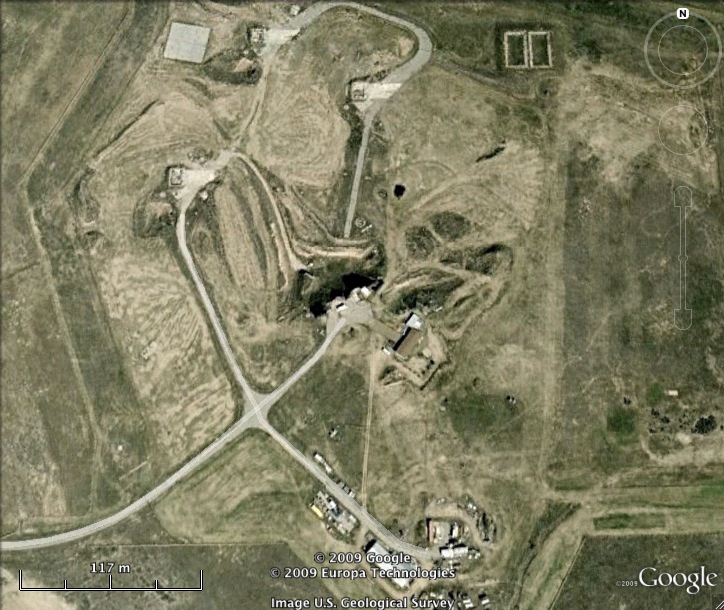
Titan I Missile Complex 569-C was the northern launch complex in the three-site Titan I field controlled by the 569th Strategic Missile Squadron at Mountain Home Air Force Base. Military records associated it with Orchard, while later location references often use Boise. The complex stood in Ada County about three miles northeast of the former Orchard community. Three HGM-25A Titan I missiles, underground launchers, a launch control center, powerhouse, guidance antenna silos, propellant and equipment terminals, tunnels, utilities, security works, and crew spaces formed one-third of Mountain Home's nine-launcher force.The military career was short but operationally complete. Construction began in 1960, the three-site field was complete before April 1, 1962, first missiles arrived in April, and the field was publicly declared operational on August 16, 1962. The 569th stood alert during the Cuban Missile Crisis. Titan I then yielded to faster, simpler, and more survivable Titan II and Minuteman systems. The 569th was inactivated on June 25, 1965.

Site C's postmilitary record is distinct from the regulated waste histories at Mountain Home Sites A and B. Government records placed the Orchard property in federal surplus inventory, private contractors salvaged its equipment, and an Idaho Supreme Court opinion documents a fatal scaffolding collapse during salvage on October 20, 1967. Federal reports then show the real-property accounting narrowing from 310.08 acres, including 255.03 acres of easements, at the end of 1968 to 255.03 acres of easements at the end of 1969.
The current official parcel record does not reproduce the entire Cold War acquisition. Ada County parcel S2709336100 contains the representative complex point and reports 56.417 acres for property year 2026. The parcel is privately owned. A 2007 Associated Press account described a private residence, vehicles, tires, and earth mounds, but a current interior survey or structural assessment was not located.
Installation Identity, Location, and Boundaries
The permanent project identity is Titan I Missile Complex 569-C. Its parent is Mountain Home Air Force Base. Military and federal property records use 569-C, Site 3, Site C, Mountain Home Air Force Missile Site No. 3, Orchard, Boise, and GSA control D-Idaho-457. These names describe the same detached launch complex in different operational, geographic, and disposal contexts.Ada County reports 56.417 acres for the current parcel. Its legal description includes portions of Sections 8, 9, and 16, Township 1 South, Range 4 East, and identifies Parcel A on Record of Survey 14777. The county layer uses Boise as the situs city and RP zoning. This is a current tax-parcel record, not an original Air Force acquisition map or a complete title opinion.

The federal surplus-property record preserves a different footprint. As of December 31, 1968, D-Idaho-457 was listed at 310.08 acres, including 255.03 acres of easements. As of December 31, 1969, the listing showed 255.03 acres and specified that the entire amount consisted of easements. The most reasonable interpretation is that the fee or other non-easement portion had left the federal inventory while easement interests remained, but that conclusion is an inference from successive reports rather than a deed-by-deed chain of title.
The current parcel, original security area, fee tracts, utility corridors, road interests, communications routes, and federal easements may overlap without being identical. No graphic or acreage value in this history merges them. Recorded deeds, easement instruments, and a professional survey control legal boundaries.
The Orchard Landscape
Complex 569-C occupied open, sparsely developed terrain south of Boise near the former Orchard community. The setting placed the northern launcher complex away from Mountain Home Air Force Base and from its sister complexes while keeping it within the command, maintenance, logistics, security, and communications network of the 569th Strategic Missile Squadron.Dispersal was a strategic design choice. Separating the three complexes reduced the chance that one attack could destroy all nine Mountain Home missiles. Distance also imposed daily operating costs. Crews, security forces, maintainers, inspectors, contractors, supplies, and spare parts moved over rural roads, while power, communications, water, sewage, drainage, and emergency systems had to support a self-contained underground installation.
The Orchard name refers to a former rural community and geographic association, not to an operating municipality that owned the missile site. Boise appears in postal, county, and modern location records. The history retains both terms because Orchard explains the Cold War identity and Boise helps locate the present parcel without erasing the historical name.
The nearby Orchard Combat Training Center is a large Idaho National Guard training landscape with a separate history, ownership pattern, and military mission. The evidence reviewed does not place parcel S2709336100 inside that training installation or show that the former missile complex became part of it. Geographic proximity is not treated as a property or command relationship.
Current private ownership and rural land use make access limits especially important. Public-road visibility, online coordinates, or a former military function do not create a right to enter. Deep shafts, altered floors, salvage damage, standing water, confined spaces, deteriorated materials, and unverified modifications can remain hazardous even where little appears on the surface.
The Mountain Home Titan I Field
Mountain Home supported three standardized three-launcher Titan I complexes: 569-A near Bruneau, 569-B near Oreana, and 569-C near Orchard and Boise. Together they provided nine launchers for the 569th Strategic Missile Squadron. Each was a distinct remote installation tied to Mountain Home AFB for command, maintenance, security, training, housing, logistics, and administration.
The 9th Bombardment Wing provided the parent organization when the missile mission arrived. The Air Force redesignated it the 9th Strategic Aerospace Wing in April 1962 to reflect combined bomber, tanker, and missile responsibilities. Mountain Home's B-47 and KC-97 missions continued while the underground field entered service.
The construction contract was publicly opened in Boise on February 5, 1960. The Kaiser-Raymond-Macco-Puget Sound team submitted the low bid of about $28.9 million, and the Air Force announced award on February 9. Official Mountain Home history reports that field costs ultimately exceeded $51 million because of labor shortages, material shipment, weather, strikes, and continuing design changes. Those are field-wide figures, not a cost assigned to 569-C alone.
The 569th was the last Titan I squadron activated by Strategic Air Command. Its late place in the deployment sequence produced a short operating life, but the Orchard complex still entered full alert status, supported the national deterrent during the Cuban Missile Crisis, and remained an operating nuclear weapon installation until the 1965 phaseout.
Design, Contracting, and Construction
Construction began in 1960 after late-1950s site studies. Titan I contractors used cut-and-cover construction: excavate immense pits, build reinforced-concrete and structural-steel rooms and shafts, install machinery and utilities, connect the components with tunnels, and backfill the plant until relatively little remained visible above ground.The Mountain Home contract transferred to the Titan I Directorate of the Corps of Engineers Ballistic Missile Construction Office in October 1960. Official base history records deep water wells, severe weather, long material routes, labor shortages, strikes, and design changes across the field. Three construction workers died during the Idaho program. The reviewed source does not assign those deaths to a particular complex, so they remain field-wide facts.
The three Idaho sites were complete before April 1, 1962, but structural completion was not combat acceptance. Elevators, doors, guidance electronics, power systems, communications, liquid-oxygen equipment, alarms, launch consoles, and government-furnished missile equipment required installation, calibration, integrated testing, and crew training before alert duty.
No site-specific 569-C construction log, contractor progress album, or as-built plan was located. Standard Titan I drawings and the Historic American Engineering Record for Lowry Complex 2A provide strong design comparisons, but they do not prove every Orchard dimension, construction change, or later alteration. The history and graphics label those materials as standard design evidence rather than a 569-C survey.

Standard Underground Design and Surface Layout The underground plant centered on a protected access route, launch control center, powerhouse, utility spaces, two guidance antenna silos, and connecting junctions. The control center housed command consoles, status displays, communications, authentication material, and crew working spaces. The powerhouse contained diesel generators and electrical distribution equipment so the complex could operate after loss of commercial power.

Three launcher branches extended from the central area. Each branch incorporated an equipment terminal, propellant terminal, connecting tunnels, and missile silo. The equipment terminal supported the launcher elevator and machinery. The propellant terminal handled RP-1 kerosene fuel and liquid-oxygen equipment. The missile remained below paired doors on an elevator and had to be fueled, raised into the open, and launched from the surface.
Two retractable guidance antennas occupied separate protected silos. Titan I carried inertial instruments but depended on radio corrections transmitted from the ground during early flight. Redundant antennas reduced the risk that a single failure would remove the guidance function. These were missile-guidance antennas, not air-search radar systems.
The HGM-25A Titan I was a two-stage liquid-propellant intercontinental ballistic missile about 98 feet long. Both stages used RP-1 and liquid oxygen. The cryogenic oxidizer could not remain loaded indefinitely, so alert procedures included fueling. Crews and maintainers monitored tanks, pumps, valves, lines, high-pressure gases, electrical power, hydraulics, doors, elevators, ventilation, and communications as one integrated weapon system.
Standard Titan I records describe three missiles per complex, a hardened control center, independent power, utility and cable tunnels, protected access, sewage and water systems, surface security fencing, patrol roads, launcher doors, antenna doors, vents, hatches, and survey features. The accompanying layout is a carefully sourced standard configuration. It is not a site-specific as-built plan or current condition map.
Propellant Loading Exercises tested each missile on a recurring cycle. These exercises verified lines, pumps, tanks, sensors, timing, communication, and emergency responses under conditions approaching a real countdown. A launch order required authenticated messages, two-person procedures, liquid-oxygen loading, guidance preparation, door operation, elevator movement, and surface ignition. Titan I was an enormous advance over aircraft-only deterrence, but the exposed fueling and elevation sequence helped drive the transition to Titan II and solid-propellant Minuteman systems.
Construction Management, Acceptance, and Technical Change
Building a Titan I field required coordination among the Air Force, Army Corps of Engineers, prime contractors, equipment manufacturers, local utilities, state and county governments, and specialized subcontractors. The field contract covered three remote complexes rather than one conventional base project. Concrete, reinforcing steel, structural steel, machinery, electrical equipment, piping, and government-furnished missile hardware had to arrive in a sequence that matched work at three deep excavations.The February 1960 award to the Kaiser-Raymond-Macco-Puget Sound team established the principal field construction organization. Federal oversight shifted in October 1960 to the Titan I Directorate of the Corps of Engineers Ballistic Missile Construction Office. This national organization was created because ordinary base-construction practice could not easily manage a missile design that was still changing while contractors built operational facilities across several states.
Design change was not a minor paperwork problem. A change to launcher doors, elevators, blast valves, electrical distribution, fuel or oxidizer equipment, communications, guidance, or environmental control could affect excavation, concrete placement, embedded conduit, equipment delivery, testing, and crew procedures. Rework increased cost and schedule pressure. The Mountain Home field's rise from an initial contract near $28.9 million to a final cost above $51 million belongs in that technical context.
Acceptance proceeded by systems and milestones. A structurally complete complex could still lack functioning doors, elevators, generators, guidance equipment, communications circuits, alarms, launch consoles, or tested missile hardware. Contractors demonstrated installed systems, engineers recorded deficiencies, Air Force activation teams conducted integrated tests, and operating crews trained on normal, emergency, and nuclear-surety procedures. The August 16, 1962 operational declaration was therefore the culmination of many turnovers rather than a single construction date.
The three field-wide construction deaths documented in official Mountain Home history show the human cost of the program. The available source does not assign them to Site C. They are not merged with the separately documented October 1967 salvage fatality, which occurred after military operations and is established by a published Idaho Supreme Court opinion.
Site Activation and Acceptance
The 569th Strategic Missile Squadron was organized at Mountain Home Air Force Base on June 1, 1961. The first Titan I missiles arrived in April 1962. Contractors and Air Force activation teams then completed installation, calibration, integrated testing, practice countdowns, and turnover of the three complexes.Idaho's Titan field was publicly declared operational on August 16, 1962, during a ceremony involving Senator Len B. Jordan. The declaration applied to the Mountain Home field and squadron. The reviewed official and secondary sources do not prove that every technical acceptance action at 569-C occurred on that exact day, so the date is labeled as a field-level operational milestone.
Activation required far more than placing missiles into silos. Elevators, doors, oxidizer systems, power generation, environmental controls, guidance antennas, communications, alarms, security systems, and launch consoles had to function together. Crews practiced normal and emergency procedures while maintenance specialists resolved deficiencies.
The declared operational date came less than two months before the Cuban Missile Crisis. The short interval illustrates the speed with which the new force moved from construction into national alert responsibility. It also explains why precise distinctions among construction completion, contractor acceptance, Air Force turnover, operational declaration, first alert, and individual missile status are necessary.
Organization and the 569TH Strategic Missile Squadron
The 569th Strategic Missile Squadron traced its lineage to the 569th Bombardment Squadron. It was redesignated for the intercontinental ballistic missile mission, activated in December 1960 without immediate organization, and organized at Mountain Home on June 1, 1961. It operated the HGM-25A Titan I under the 9th Bombardment Wing and then the 9th Strategic Aerospace Wing.The squadron used a three-by-three deployment. Complexes 569-A, 569-B, and 569-C each held three launchers. A crew at Orchard controlled one complete three-missile complex, while squadron leadership, maintenance, security, communications, and parent-wing support connected the three remote installations to Mountain Home AFB.
Personnel trained in nuclear command and control, authentication, console procedures, liquid-oxygen safety, electrical and hydraulic systems, guidance, communications, security, fire protection, and emergency response. Titan I's labor-intensive design required extensive daily surveillance and periodic propellant-loading exercises.
The missile squadron was part of a broader Strategic Air Command installation. The 9th wing also operated alert bombers and tankers. The combined mission produced the 1962 Strategic Aerospace Wing designation, but Orchard remained a distinct remote launch installation rather than a section of the airfield property.
Remote Crew Life, Logistics, and Emergency Readiness
Site C functioned as a remote duty station rather than a self-sufficient base community. Missile combat crews could operate the launch complex, but Mountain Home AFB supplied the larger institutional framework: training, personnel administration, medical support, security organization, maintenance management, spare parts, transportation, housing, food services, and wing command. The relationship explains why the detached complex requires its own installation identity while retaining Mountain Home as its parent.Shift turnover depended on disciplined records. Incoming personnel needed accurate launcher status, maintenance discrepancies, security conditions, communications checks, test schedules, and restrictions on equipment. Nuclear operations required controlled access, authentication procedures, two-person practices, and careful custody of classified and sensitive material. A missed discrepancy or casual shortcut could remove a launcher from alert or create a safety risk.
The underground environment required constant mechanical support. Ventilation controlled heat, humidity, fumes, and equipment conditions. Pumps managed water and drainage. Diesel generators and electrical switchgear provided backup power. Hydraulic systems moved massive doors and elevators. Water, sewage, lighting, communications, fire protection, and escape provisions protected personnel. The installation was hardened against attack, but daily reliability depended on ordinary maintenance performed to exceptional standards.
Remote location complicated emergency response. Fire, medical, security, propellant, confined-space, electrical, and mechanical emergencies demanded site procedures and coordination with the parent base. Liquid oxygen presented intense cold and compatibility hazards. RP-1, diesel fuel, lubricants, batteries, high-pressure gases, and electrical equipment added different risks. Training had to cover isolation, delayed outside assistance, and the possibility that several systems could fail during the same event.
Missile alert was repetitive by design. Crews watched indicators, tested circuits, authenticated messages, recorded status, and practiced emergency actions while hoping never to execute the combat mission. Maintenance teams inspected machinery that usually remained stationary but had to work immediately on command. The apparent quiet of a buried installation concealed a continuous cycle of surveillance, testing, documentation, repair, and certification.
The Orchard complex's strategic value came from readiness and dispersal, not visible activity. Its three missiles contributed to a nine-launcher squadron and a national force. The site deterred attack by convincing an adversary that buried, separated weapons and trained crews could survive long enough to retaliate. That purpose gives routine work, not only crisis events, a central place in the historical record.
Alert Operations
Alert duty combined routine checks with readiness for an event of extraordinary consequence. Crews monitored status lights, communications, environmental controls, electrical systems, security reports, and missile condition. They maintained logs, ran prescribed tests, and followed two-person control procedures. Security forces controlled entry and patrolled the surface, while maintenance teams responded to equipment discrepancies without compromising nuclear surety.The underground complex was designed to continue functioning after outside utilities failed. Diesel generation, stored supplies, filtered ventilation, protected communications, and hardened access supported survivability. Hardening did not make the installation invulnerable. Its dispersal, burial, blast-resistant construction, redundancy, and rapid launch sequence together sought to preserve retaliatory capability long enough to deter attack.
Titan I's cryogenic design placed a special burden on alert operations. Liquid oxygen could not remain indefinitely in the missile. A launch order would initiate a controlled sequence involving authentication, system checks, propellant loading, guidance preparation, silo-door operation, elevator movement, and surface launch. The need to raise the missile left the weapon exposed during the final sequence, one reason later Titan II and Minuteman systems emphasized in-silo launch and more readily stored propellants.
The radio-guidance system linked the missile to protected ground antennas. Inertial instruments provided basic navigation, while ground equipment calculated and transmitted corrections during early flight. That arrangement demanded reliable electronics, precise surveying, communication among subsystems, and functioning antenna machinery. Guidance was not an accessory. It was part of the operational weapon system.
The Cuban Missile Crisis
The squadron reached operational status just weeks before the Cuban Missile Crisis of October 1962. The timing placed the new Mountain Home force on alert during the most dangerous confrontation of the Cold War. Official sources establish the squadron's operational status and the national alert environment, but the records reviewed do not provide a surviving 569-C crew log or a site-specific narrative of those days.The significance therefore lies in confirmed readiness rather than invented drama. Men at Orchard maintained a live intercontinental ballistic missile installation while national command authorities confronted Soviet missile deployment in Cuba. Communications, authentication, security, mechanical reliability, and disciplined adherence to procedure all carried immediate strategic importance. The site's purpose was deterrence, and the crisis tested whether that deterrent could be presented as credible without being used.
Communications, Guidance, Power, Security, and Maintenance
Reliable communications connected the remote complex to squadron and Strategic Air Command channels. Emergency Action Messages required authentication and controlled handling. Two-person procedures reduced the possibility that one individual could initiate critical actions. Exact equipment complements changed during construction and service, and no complete 569-C communications inventory was located, so standard Titan I functions are described without assigning an unsupported model number to every rack or circuit.The powerhouse served as the site's mechanical heart. Multiple diesel generators, switchgear, batteries, hydraulic equipment, ventilation, pumps, and cooling systems allowed the complex to support missile readiness independent of ordinary utilities. Machinery also created maintenance demands and potential environmental sources. Fuels, lubricants, solvents, electrical components, sumps, drains, and wastewater systems later became part of the broader environmental inquiry at former missile sites.
Security began with remoteness, fencing, controlled gates, alarms, patrols, identification procedures, and armed response. It continued underground through protected portals and controlled areas. Modern private ownership and the visibility of large surface doors do not erase those historic layers, but neither do they make the site safe to enter. Deep shafts, decayed floors, unguarded openings, poor air, standing water, electrical remnants, and contaminated media can turn curiosity into a fatal hazard.
Maintenance was continuous because Titan I combined cryogenic propellant systems, high-pressure gases, mechanical elevators, heavy doors, guidance electronics, power generation, ventilation, and early command equipment. A failure in one component could remove a launcher from alert. Preventive maintenance, periodic tests, parts supply, contractor support, and disciplined documentation were as essential to readiness as the missile itself.
Phaseout and Deactivation
Titan I became obsolete rapidly as Titan II and Minuteman offered faster reaction, simpler alert procedures, improved survivability, and launch directly from the silo. Headquarters Air Force decided in May 1963 to phase out Titan I. Secretary of Defense Robert McNamara accelerated the schedule in 1964, and closure of Mountain Home's sites was announced that November.The Mountain Home field left alert during the nationwide 1965 drawdown. The 569th Strategic Missile Squadron was inactivated on June 25, 1965. Missiles, classified material, reusable equipment, wiring, and valuable metals were removed during decommissioning. Exact launcher-by-launcher alert termination dates for 569-C were not located and are not invented.
The federal government then treated the detached complex as surplus real property while contractors carried out salvage. Removal of machinery and metals changed the installation physically and created industrial hazards unrelated to normal missile operations. The process was neither an orderly museum conversion nor immediate abandonment.
The 1968 federal surplus-property report identified the installation as Mountain Home AFB, Air Force Facility S-3, Mountain Home, GSA control D-Idaho-457. It listed a reported cost of $18.849 million, but that accounting value should not be mistaken for the original construction contract or the final cost of the three-site Idaho field.
Disposal, Salvage, and Private Ownership
The Idaho Supreme Court's 1970 opinion in Adam v. Titan Equipment Supply Corporation provides the most specific account of postmilitary salvage at Site C. The opinion states that the government abandoned Titan Missile Site C near Orchard and placed it on a salvage list. Rigging and Erection Company secured the salvage rights and later assigned them to Titan Equipment Supply Corporation.The court described a ten-foot wire-mesh fence topped with barbed wire and an installation containing three missile silos, a command bunker, underground tunnels, and storage areas. Titan Equipment controlled possession and access and employed five workers. By autumn 1967 it had been salvaging the complex for about five months.
In September 1967 Titan Equipment entered an arrangement with Roy Mays for labor and equipment, with compensation based largely on sharing removed salvage. Floyd Duane Adam worked for Mays. On October 20, 1967, Adam was killed when scaffolding collapsed while he was dismantling equipment at the former missile site.
The published decision concerned statutory employer responsibility under Idaho law. It is not a military accident report or a comprehensive occupational-safety investigation. Even so, it establishes the location, control, salvage activity, physical character, approximate timing, and fatality with much greater authority than later anecdotes about an abandoned silo.
Federal surplus reports add the property-accounting sequence. The December 31, 1968 inventory listed 310.08 acres, including 255.03 acres of easements. The December 31, 1969 report listed 255.03 acres, all described as easements. The disappearance of 55.05 non-easement acres from the later inventory strongly suggests a disposal or accounting transition, but the reports alone do not establish the grantee, exact deed date, or every retained right.
Later summaries state that the site passed into private ownership. The official 2026 Ada County parcel layer confirms private ownership of the 56.417-acre parcel containing the representative complex point.
Environmental Registration and Response
No site-specific environmental permit, cleanup decision, or active federal remediation record for 569-C was confirmed in the public EPA, Idaho Department of Environmental Quality, and former military property indexes reviewed. That absence must not be interpreted as proof that the site is uncontaminated, formally closed to modern standards, or free of continuing hazards.Titan I complexes used diesel fuel, RP-1 kerosene, liquid oxygen, high-pressure gases, hydraulic fluids, lubricants, batteries, solvents, cooling and water-treatment chemicals, sewage systems, electrical equipment, and numerous industrial materials. Decommissioning and salvage introduced cutting, dismantling, falling-object, confined-space, and structural risks. The 1967 fatality confirms that postmilitary work itself was hazardous.
Site-specific claims require sampling reports, agency determinations, deeds, closure records, or professional inspections. Environmental findings from the Bruneau and Oreana complexes cannot be transferred to Orchard merely because the three sites shared a military design. Site A and Site B became regulated waste properties with separate records. Site C requires its own evidence.
Current and future investigators should treat deep shafts, weakened concrete, corroded steel, missing railings and floors, standing water, poor air, electrical remnants, buried utilities, salvage debris, and unknown fill or modification as potential hazards. These cautions are based on the installation type and salvage history. They are not a substitute for a site-specific engineering or environmental assessment.
Surviving Features and Current Status
The official 2026 Ada County parcel layer establishes a current 56.417-acre privately owned parcel containing the representative complex point. It does not inventory buildings, tunnels, shafts, or preserved missile equipment. The county data therefore support current parcel identity and acreage, not an architectural condition judgment.A January 2007 Associated Press report described the property as private and noted a mobile home, vehicles, tires, earth mounds, and owners who declined access and photography. That report is a dated surface snapshot, not proof of the site's condition in 2026. It is useful because it confirms private residential or rural-property use and the difficulty of interpreting the former complex from outside the property.
Secondary visitor accounts report little distinctive equipment visible from the gate. Unofficial accounts also describe underground exploration, but such material does not establish permission, safety, exact date, completeness, or professional condition.
Reinforced-concrete structures may survive beneath altered ground, but exact accessibility, water levels, salvage completeness, structural integrity, and current modifications remain unverified. The former complex should be described as surviving in unknown and altered condition rather than intact, destroyed, flooded, or accessible.
Current use is best stated conservatively: private rural property on the footprint of a decommissioned missile complex, with a 2007 report of residential, vehicle, tire, and earthwork activity.
Detailed Chronology
- Late 1950s The Air Force evaluates southern Idaho locations for a three-complex Titan I field supported by Mountain Home Air Force Base.
- February 5, 1960 Bids for the Mountain Home Titan I field are opened at the Idaho Capitol in Boise. The Kaiser-Raymond-Macco-Puget Sound team submits the apparent low bid of about $28.9 million.
- February 9, 1960 The Air Force announces the construction award for the three-site Mountain Home field.
- 1960 Construction begins at Bruneau, Oreana, and Orchard or Boise.
- October 1960 Construction oversight transfers to the Titan I Directorate of the Corps of Engineers Ballistic Missile Construction Office.
- December 12, 1960 The 569th Strategic Missile Squadron is activated in designation but is not yet organized.
- June 1, 1961 The 569th Strategic Missile Squadron is organized at Mountain Home Air Force Base.
- Before April 1, 1962 Official Mountain Home history says construction of all three Idaho complexes is completed before the contractual deadline.
- April 1962 The first Titan I missiles arrive for the Mountain Home field, and the 9th Bombardment Wing becomes the 9th Strategic Aerospace Wing.
- August 16, 1962 The Mountain Home Titan I field is publicly declared operational.
- October 1962 The newly operational 569th field stands alert during the Cuban Missile Crisis.
- May 1963 Headquarters Air Force decides to phase Titan I out of the operational force.
- May 1964 Secretary of Defense Robert McNamara directs an accelerated Titan I phaseout.
- November 1964 The Air Force announces closure of the Mountain Home missile sites.
- January to April 1965 The nationwide Titan I force leaves alert.
- June 25, 1965 The 569th Strategic Missile Squadron is inactivated.
- 1965 to 1966 Missiles, classified equipment, reusable machinery, wiring, and valuable metals are removed during decommissioning and salvage preparation.
- About May 1967 Titan Equipment Supply Corporation is engaged in salvage at Site C, based on the later court opinion's statement that work had continued about five months by October.
- September 1967 Titan Equipment reaches an agreement with Roy Mays for labor and equipment to assist with salvage.
- October 20, 1967 Floyd Duane Adam is killed when scaffolding collapses during equipment dismantling at Site C.
- December 31, 1968 The federal surplus-property inventory lists D-Idaho-457 at 310.08 acres, including 255.03 acres of easements, and a reported cost of $18.849 million.
- December 31, 1969 The federal surplus-property inventory lists 255.03 acres, all described as easements. The change indicates that non-easement property had left or changed within the inventory, but the report does not provide the deed chain.
- June 15, 1970 The Idaho Supreme Court issues Adam v. Titan Equipment Supply Corporation, preserving the legal record of Site C salvage and the 1967 fatality.
- January 17, 2007 An Associated Press report describes the private property, surface residential and vehicle use, tires, earth mounds, and owners declining access and photography.
- 2026 The official Ada County parcel layer reports parcel S2709336100 at 56.417 acres and privately owned. The representative complex point falls within the parcel polygon.


Sources & References
- WEB Peace Through Deterrence: the Titan ICBM Program SOURCE FOR: Official Mountain Home field history, construction cost growth, construction difficulties, worker fatalities, April 1962 completion, missile arrival, operational declaration, deactivation, and postmilitary context
- WEB 366th Fighter Wing Fact Sheet SOURCE FOR: Official parent-base chronology, three Titan sites, 569th assignment, 9th Strategic Aerospace Wing redesignation, and 1964 closure announcement
- PDF Locating Air Force Base Sites: History's Legacy SOURCE FOR: Official Air Force strategic-basing context, Mountain Home and 569th assignment, and installation-selection framework
- PDF The Development of Ballistic Missiles in the United States Air Force, 1945-1960 SOURCE FOR: Official Air Force Titan development, guidance, propulsion, basing, testing, and program decisions
- PDF SAC Missile Chronology 1939-1988 SOURCE FOR: Strategic Air Command activation, operational, alert, phaseout, and inactivation chronology
- PDF To Defend and Deter: The Legacy of the United States Cold War Missile Program SOURCE FOR: National Titan I program context, Mountain Home Site 3 identification, Orchard location, and later private-property summary
- WEB The Titan Missile, National Park Service SOURCE FOR: Titan I dimensions, warhead and range context, three-missile configuration, fueling, response time, hardening, and operational deployment
- PDF Titan I Missile Complex 2A, HAER CO-89 SOURCE FOR: Standard Titan I engineering, construction, launcher design, guidance, crew operations, deactivation, and comparative design documentation
- WEB Adam v. Titan Equipment Supply Corporation, 93 Idaho 644, 470 P.2d 409 SOURCE FOR: Site C salvage rights, fence and underground features, contractor control, five-worker salvage operation, September 1967 agreement, October 20, 1967 fatality, and statutory-employer dispute
- PDF Congressional Record, May 5, 1969, Surplus Property on Hand December 31, 1968 SOURCE FOR: GSA control D-Idaho-457, Air Force Facility S-3 identity, 310.08-acre federal inventory, 255.03 acres of easements, and reported cost
- PDF Congressional Record, February 9, 1970, Surplus Real Property on Hand December 31, 1969 SOURCE FOR: D-Idaho-457 listing of 255.03 acres consisting entirely of easements and comparison with the 1968 inventory
- WEB Ada County Assessor Open Data Parcel Layer, OG_parcelbase2 SOURCE FOR: Official 2026 parcel S2709336100, 56.417 acres, private ownership status, situs city, zoning, legal-description fields, and parcel polygon containing the representative complex point
- WEB Private Property: Former Titan Missile Site near Orchard SOURCE FOR: January 2007 surface-use snapshot, private-property status, residence, vehicles, tires, earth mounds, and owners declining access and photography
- WEB Idaho Architecture Project, Titan Missile Site C SOURCE FOR: Ada County identity, private status, and public-access limitation in a statewide architectural inventory
- WEB Historic American Engineering Record, Titan I Missile Complex 2A Collection SOURCE FOR: Standard Titan I photographs, measured drawings, and engineering documentation used as clearly labeled comparisons rather than 569-C site-specific evidence
- WEB Orchard Combat Training Center Integrated Natural Resources Management Plan SOURCE FOR: Official description of the separate Idaho National Guard training installation in the broader Orchard area and evidence supporting the geographic-neighbor distinction