
Titan I 395-A Missile Silo Vandenberg AFB California
Titan I 395-A
Date Activated: September 23rd 1961
Date Deactivated: March 20th 1965
Air Force Base: Vandenberg
State: California
Coordinates:
Latitude: 34°48'22.52"N
Longitude: 120°32'41.41"W
Decimal:
Longitude: -120.544836
Latitude: 34 48.3753333333333
Longitude: -120 32.6901666666667
List of all Titan I site Coordinates
Detailed information about the Titan I Intercontinental Ballistic Missile can be found here.


Overview
Complex 395-A was Vandenberg's three-launcher Titan I test and training installation, not an operational field complex deployed on nuclear alert. It gave the Air Force a place to launch an underground-based Titan I from a configuration related to the installations being constructed around the country. The first 395-A launch took place on September 23, 1961, and the last documented launch was on March 5, 1965. The Air Force launch registry and the Space Force Museum together identify 19 launches: 11 from A-1, four from A-2, and four from A-3. The complex supported research, training and demonstration, Strategic Air Command evaluations, and target flights for the Army's anti-ballistic-missile research.
The history is unusually well documented in launch records and historic photographs, but the sources require careful separation. Vandenberg's first Titan I flight on May 3, 1961 came from the separate Silo Launch Test Facility, or SLTF, not from 395-A. A separate Operational System Test Facility, or OSTF, suffered a destructive simulated-launch accident in December 1960 and never made an actual launch. Sites 395-B, 395-C, and 395-D belonged to the later Titan II program. Merging those installations would falsely assign events, structures, and missions to 395-A.
Installation Identity and Location
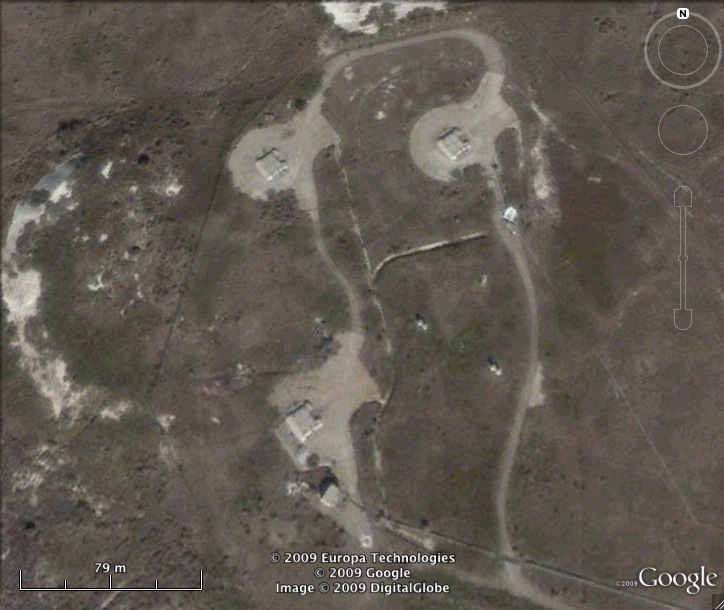
The permanent project identity is Vandenberg Titan I Complex 395-A. Its three individual launch emplacements were 395 A-1, 395 A-2, and 395 A-3, with Air Force building numbers 1875, 1877, and 1879 respectively. The Space Force Museum also uses Test and Training Facility 1 as an alternate name. These labels identify one integrated launch complex with three distinct firing positions, not three unrelated installations. The parent base is Vandenberg.
The Space Force Museum's historic base map confirms the complex in the northern part of the installation but is not a survey of the three launchers. No reviewed source supplies a verified 395-A legal boundary or facility-specific acreage. The site remains inside an active military installation, so neither the point nor the graphics imply public entry or an available visitor route.
Why Vandenberg Needed a Titan I Test Complex
Vandenberg was established as the West Coast range for training missile crews and testing strategic missiles under realistic launch conditions. Its coastal geography allowed launches over the Pacific while reducing the exposure of populated areas, and the range supplied tracking, communications, safety, recovery, and instrumentation support. Air Research and Development Command was responsible for construction and development testing, while Strategic Air Command needed representative launch facilities for crews and operational evaluations. Complex 395-A sat at that intersection of weapon development, force preparation, and range operations.Titan I was the United States' first operational multistage intercontinental ballistic missile. Its RP-1 fuel and liquid-oxygen oxidizer, radio-inertial guidance, elaborate underground support plant, and surface-launch requirement made it a technically demanding system. An alert missile in a field complex remained protected below ground until the launch sequence opened its door and raised it on an elevator. A test complex had to demonstrate that the missile, elevator, ground equipment, crew procedures, range interfaces, and guidance equipment could work together. Vandenberg's three-launcher plant provided that evidence without being one of the six operational Titan I squadron fields.
Construction and Acceptance
The 2005 Air Force environmental assessment states that 395-A was built between 1958 and 1960. The Space Force Museum dates the start of construction to May 13, 1960 and completion to late 1960. Those statements can be read as different levels of project chronology, but the public sources do not explain their exact scope. This history preserves both rather than silently replacing one. The Air Force facility guide gives more precise acceptance milestones: A-1 and A-2 on August 30, 1960, and A-3 on September 27, 1960. Acceptance of the brick-and-mortar launchers did not itself establish that missile installation, checkout, instrumentation, crews, and range safety were ready for flight.The complex was built around three hardened silo-lift emplacements. At a Titan I installation, the buried launchers depended on propellant handling, liquid oxygen, power, ventilation, communications, checkout, guidance, access, security, and personnel support. Historic photographs of 395-A show missiles raised above the surface with service equipment nearby, a visible reminder that a hardened storage position was only one part of a launch system. No reviewed as-built 395-A plan verifies the precise location or dimensions of every tunnel and support room, so any standard-plan illustration is labeled as an engineering comparison rather than a surveyed complex layout.
Three Launchers, One Integrated Test Plant
A-1 became the most heavily used launcher, with 11 of the 19 recorded flights. It made the complex's first flight on September 23, 1961 and its last on December 8, 1964. A-3 first flew on January 20, 1962 and last flew on January 14, 1965. A-2 was accepted in 1960 but did not make its first recorded flight until March 30, 1963, when it launched a Nike-Zeus target. Its last recorded flight took place on March 5, 1965. The different first-use dates show why an acceptance date, a complex first-launch date, and an individual silo first-launch date cannot be treated as interchangeable.
The official Vandenberg facility guide calls all three emplacements hardened silo-lift structures and lists them as Titan I special-test facilities. Elevators brought missiles to the surface before firing, unlike Titan II's later in-silo launch technique. The 395-A missiles were not a trio of permanently ready warheads serving a local combat-alert field. They were test vehicles prepared for a scheduled range event, with instrumentation, safety review, command coordination, and mission objectives appropriate to each flight. Individual launches could still exercise practices of direct value to operational Titan I squadrons.
Research, Demonstration, and Strategic Test Flights
The first 395-A flight, BIG SAM, lifted from A-1 on September 23, 1961 and is categorized as research and development in the official launch summary. The A-3 launch DOUBLE MARTINI on January 20, 1962 is listed as a demonstration. A-1 then carried a succession of development and strategic-test flights through 1962 and early 1963. The registry's operation nicknames make it possible to distinguish these events from the first Vandenberg Titan I launch, SILVER SADDLE, which used the separate SLTF on May 3, 1961.
Beginning in 1963, the mission mix broadened. The official launch registry identifies SILVER SPUR, HIGH RIVER, POLAR ROUTE, DAILY MAIL, and FAST RIDE as Demonstration and Shakedown Operation flights from the three 395-A emplacements. A DASO tested the weapon system and the operating organization, not just a missile airframe. Later WEST WING I, WEST WIND III, and WEST WIND II are categorized as strategic tests. The records establish this progression from development and demonstration toward repeatable operational evaluation, although they do not provide detailed postflight performance findings for every mission.
Army Nike-Zeus Target Role
Complex 395-A also contributed to a joint Air Force and Army effort to test defense against ballistic missiles. The official registry categorizes YOUNG BLOOD from A-2 on March 30, 1963 and RAMP ROOSTER from A-3 on April 13, 1963 as Nike target flights. The U.S. Army's history of strategic air and ballistic missile defense separately confirms that a Nike-Zeus missile fired against a Vandenberg-launched ICBM target on March 30 and describes a high-altitude intercept test at Kwajalein. Those two official records together connect the A-2 launch to the Army test without converting 395-A itself into an Army installation.
The 2005 Air Force assessment says the complex supplied ten Titan missile targets for the Nike-Zeus program between March 1963 and the end of March 1965. That summary conflicts with the official chronological Vandenberg launch registry, which identifies only two 395-A flights explicitly as Nike targets and lists 19 total 395-A launches. The difference may reflect differing program accounting or an error in the retrospective assessment, but the reviewed public evidence does not resolve it.
The 395th Strategic Missile Squadron and Range Network
The 395th Strategic Missile Squadron was Vandenberg's Titan operational and training unit. The official Air Force ballistic missile history identifies it alongside the 576th Strategic Missile Squadron for Atlas and the 394th for Minuteman as Vandenberg operational and training organizations. The 1st Strategic Aerospace Division provided a higher-level command setting for the missile activity, while Air Force Systems Command and its predecessor development organization appear in the early flight records. Strategic Air Command appears in many of the later target and DASO records. The command column in the launch summary describes sponsorship or responsibility for an individual event, not a simple ownership transfer of the physical complex on each launch date.The complex relied on Vandenberg's larger range for tracking, telemetry, safety, communications, launch scheduling, weather assessment, and downrange support. A missile target for Nike-Zeus had to be synchronized with Army sensors and intercept operations thousands of miles away, while a DASO needed SAC personnel, technical evaluation, and an instrumented trajectory. The launch silos therefore were the most conspicuous local structures, but they were only one node in a much larger missile test network. This network role explains why a site built for Titan I remained historically consequential even though its launch period was short.
Role in the Wider Military Network
Vandenberg connected missile developers, Strategic Air Command operators, and the Army's anti-ballistic-missile test program. Complex 395-A contributed a realistic Titan I launch environment and missile targets, but it did not replace the dispersed operational sites in Colorado, Idaho, South Dakota, Washington, or California. The separate OSTF tested the weapon-system installation, while the SLTF examined a distinct in-silo launch question related to Titan II development. Nearby 395-B, 395-C, and 395-D later served Titan II test missions. Those physically and technically different installations should be linked as related records without collapsing their timelines into one page.
Phaseout and the End of Launch Operations
Titan I's working life was brief because solid-fueled Minuteman and storable-propellant Titan II offered a more sustainable strategic force. Minuteman could remain fueled and launch directly from a smaller silo. Titan II could launch from inside its silo. Titan I still needed liquid oxygen and a missile elevator, with large maintenance and support demands. As the Air Force phased out Titan I, Vandenberg used 395-A for final strategic tests rather than converting it into a Titan II launcher.The last A-1 flight was WEST WING I on December 8, 1964, and the last A-3 flight was WEST WIND III on January 14, 1965. The chronological registry records WEST WIND II from A-2 on March 5, 1965 as the last Vandenberg Titan I flight. One facility-summary table in the same official document says March 3 for A-2, while the Space Force Museum agrees with the dated March 5 launch entry. The museum's A-1 highlight also says December 8, 1963, apparently one year early. This history uses the specific chronological entries and explicitly retains those internal discrepancies for future archival verification.
After the Titan I mission ended, the Air Force decommissioned the complex and removed most useful and important equipment. This is supported by the 2005 environmental assessment and the facility guide. It does not prove that every underground cavity was filled, that every surface feature was removed, or that all residual hazards were eliminated. The reviewed public record does not provide a single formal facility closing order, date of all equipment removal, or complete as-left engineering survey. March 5, 1965 is therefore a last-launch date, not a fabricated property closure date.
Historic Preservation and 2005 Demolition Proposal
The Air Force's 2005 programmatic environmental assessment reports that 395-A lacked enough historic functional integrity to qualify for the National Register of Historic Places, citing a 1997 evaluation. That conclusion concerns the launch complex's eligibility after decommissioning and stripping, not its importance to the Titan I story. The same assessment identified nearby archaeological resources associated with the San Antonio Terrace Archaeological District. It said two sites and two isolated artifacts lay within a quarter mile of the complex, but none were within 200 meters of the reviewed facility buildings. Launch-facility preservation and archaeological protection were separate questions.
The assessment proposed demolition of buildings 1853 and 1874 within the 395-A facility. Its table did not identify an eligible historic building or direct archaeological conflict for that proposed work. A proposed action is not proof that demolition was carried out, and the document does not certify the current condition of A-1, A-2, A-3, or all supporting structures. Building 1853 was also identified in habitat review as a day roost for Townsend's big-eared bat, demonstrating that later facility management involved natural-resource as well as historic-resource considerations. Specific demolition completion and present reuse require more recent Vandenberg real-property or environmental records.
Current Status, Access, and Evidence Limits
Vandenberg Air Force Base was renamed Vandenberg Space Force Base in 2021, but that parent-base name change did not reactivate the Titan I complex. The historic silos and support buildings occupy land within an active Space Force installation. The available official public sources establish decommissioning and a 2005 demolition proposal; they do not establish that the site is a museum, that it has been redeveloped, that the silos are safe to enter, or that visitors can approach them. Current ownership is federal through the active base at the installation level, but no public facility-specific property schedule was located for a precise 395-A acreage claim.There is no reviewed USACE Formerly Used Defense Sites record for 395-A. That absence is expected because the complex remains within an active military installation; it is not evidence that soil, groundwater, former propellant systems, buried utilities, or structures have been assessed and cleared. The 2005 assessment is an environmental-planning document with a specific proposed demolition scope, not a comprehensive present-day contamination certificate. Any site-condition statement beyond decommissioning should await current official records or a documented inspection.
Photographic and Graphic Interpretation
The Space Force Museum preserves historic photographs specifically identified as 395-A: a December 10, 1961 view of the three launch positions, an August 1961 A-2 missile view, an October 6, 1962 A-1 launch view, and an August 30, 1963 A-3 launch view. These are far stronger visual evidence than a generic Titan I rendering. The A-1 and A-3 photographs show the actual missile form and launch environment, while the three-position photograph shows how service equipment and open surface space surrounded the raised vehicles. The dates and identifications are the museum's archive captions; no uncaptioned image is relabeled as 395-A.The accompanying graphics use those documented photographs, the museum's historic complex-location map, the official launch registry, and the 2005 assessment. A standard Titan I layout may be useful for explaining the functional system, but it is explicitly not an as-built 395-A map. A launch timeline does not imply every dated flight had the same objective. The condition graphic distinguishes decommissioning, historic-resource evaluation, and demolition proposal from verified present-day completion. Those distinctions are essential if the graphics are reused apart from this text.
Chronology
- 1958-1960 The Air Force environmental assessment's broad construction period for Complex 395-A.
- 1960-05-13 Space Force Museum date for the start of 395-A construction; scope differs from the broader Air Force period.
- 1960-08-30 Air Force accepts launch emplacements A-1 and A-2 as brick-and-mortar facilities.
- 1960-09-27 Air Force accepts launch emplacement A-3.
- 1960-12-03 A separate Titan I OSTF is destroyed during a simulated launch; this is not a 395-A launch.
- 1961-05-03 SILVER SADDLE becomes Vandenberg's first Titan I launch from the separate SLTF, not 395-A.
- 1961-09-23 BIG SAM, an Air Force research and development flight, becomes the first 395-A launch from A-1.
- 1962-01-20 DOUBLE MARTINI makes A-3's first launch, categorized as a demonstration.
- 1962-02-23 BLUE GANDER launches from A-1 for research and development.
- 1962-05-04 SILVER TOP launches from A-1 for research and development.
- 1962-10-06 TIGHT BRACELET launches from A-1, listed as a strategic test.
- 1962-12-05 YELLOW JACKET launches from A-1 for research and development.
- 1963-01-29 TEN MEN launches from A-1 for research and development.
- 1963-03-30 YOUNG BLOOD makes A-2's first flight as a Nike-Zeus target; the Army records a related intercept test.
- 1963-04-04 HALF MOON launches from A-1 for research and development.
- 1963-04-13 RAMP ROOSTER launches from A-3 as a Nike target.
- 1963-05-01 MARES TAIL launches from A-1 for research and development.
- 1963-07-16 SILVER SPUR launches from A-2 as a Strategic Air Command DASO.
- 1963-08-15 HIGH RIVER launches from A-1 as a DASO.
- 1963-08-30 POLAR ROUTE launches from A-3 as a DASO; the Space Force Museum preserves a photograph of this launch.
- 1963-09-17 DAILY MAIL launches from A-2 as a DASO.
- 1963-11-14 FAST RIDE launches from A-1 as a DASO.
- 1964-12-08 WEST WING I is A-1's final recorded launch, listed as a strategic test.
- 1965-01-14 WEST WIND III is A-3's final recorded launch, listed as a strategic test.
- 1965-03-05 WEST WIND II is A-2's and the complex's final recorded launch in the chronological registry.
- 1997 Historic-resource evaluation cited later by the Air Force finds the stripped complex lacks National Register integrity.
- 2005-09-13 Final Air Force environmental assessment proposes demolition of buildings 1853 and 1874 at 395-A; completion is not established by this proposal.
- 2021-05-14 The parent installation becomes Vandenberg Space Force Base; 395-A remains a former Titan I facility.

Sources & References
- PDF Vandenberg AFB Launch Summary, 1958-2000, 30th Space Wing Office of History, February 3, 2000 SOURCE FOR: Official dated 395-A launch entries, nicknames, mission categories, launcher building numbers, acceptance and first-use dates, decommissioned status, and the distinct OSTF and SLTF records. The facility table's March 3 A-2 date conflicts with its March 5 chronology.
- WEB Complex 395A, Cape Canaveral Space Force Museum archive SOURCE FOR: Alternate Test and Training Facility 1 name, construction dates, 11/4/4 launcher totals, historic location map, identified photographs, decommissioned condition, and March 5, 1965 A-2 date. Its A-1 last-launch year conflicts with the official chronology.
- PDF Final Programmatic Environmental Assessment, Demolition and Abandonment of Atlas and Titan Facilities, Vandenberg Air Force Base, September 13, 2005 SOURCE FOR: Broad construction period, mission summary, decommissioning, historic-resource evaluation, archaeological setting, proposed buildings 1853 and 1874 demolition, and habitat review. Its Nike target count conflicts with the flight-by-flight launch registry.
- PDF History of Strategic Air and Ballistic Missile Defense, 1956-1972, Volume II, U.S. Army Center of Military History SOURCE FOR: Army account of the March 30, 1963 Nike-Zeus intercept test against a Vandenberg-launched ICBM target and wider antiballistic-missile context.
- PDF The Development of Ballistic Missiles in the United States Air Force, 1945-1960, U.S. Air Force History and Museums Program SOURCE FOR: Titan I technology, operational and training unit context at Vandenberg, and first-generation ICBM phaseout context.
- WEB The History and Heritage of Vandenberg Space Force Base, U.S. Space Force SOURCE FOR: Vandenberg's West Coast test-range mission and parent-base historical context.
- WEB Titan One Missile Complex 2A, Historic American Engineering Record CO-89, Library of Congress SOURCE FOR: Standard Titan I engineering relationships and illustration reference only; not an as-built 395-A plan.
- WEB Cold War Geodesy: U.S. Titan I ICBM Locations SOURCE FOR: Published representative 395-A coordinate; used as an approximate site point rather than a surveyed launcher, boundary, or access location.