
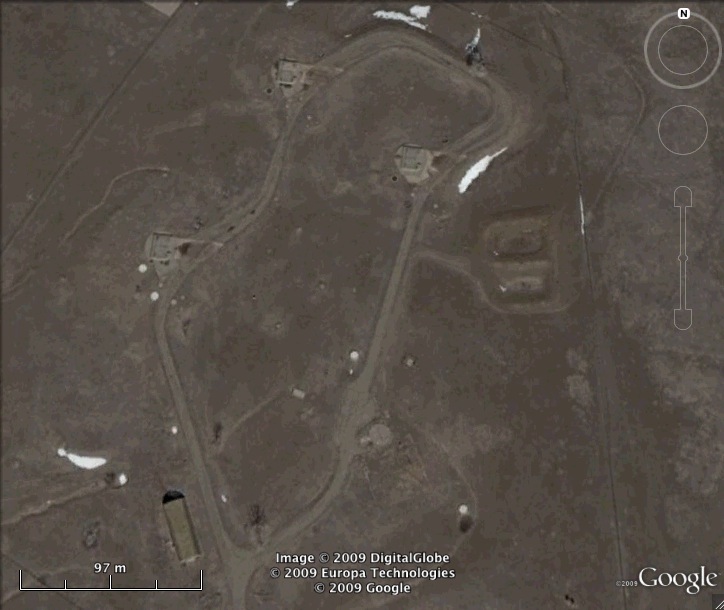
Titan I 724-A Missile Silo Lowry AFB Colorado
Titan I 724-A
Squadron: 724th SMS
Date Activated: February 1st 1960
Date Deactivated: June 25th 1965
Air Force Base: Lowry
State: Colorado
Nearest Town: Bennett
Coordinates:
Latitude: 39°38'52.57"N
Longitude: 104°41'24.54"W
Decimal:
Longitude: -104.69015
Latitude: 39 38.8761666666667
Longitude: -104 41.409
3 silos
Former Titan I Missile Complex with the 724th Strategic Missile Squadron
First 724th SMS Titan I alert: April 20, 1962
Unit inactivation: June 25, 1965
Present status: Former nonfederal missile property; exact 2026 ownership, use, access, and condition unverified
Approximate Installation Size: 442 Acres
Read about the Titan I at Lowry AFB
List of all Titan I site Coordinates
Detailed information about the Titan I Intercontinental Ballistic Missile can be found here.


Overview
Titan I Missile Complex 724-A was one of three hardened intercontinental ballistic missile launch complexes operated by the 724th Strategic Missile Squadron from Lowry Air Force Base. Built east of Denver on the northwestern portion of the former Lowry Bombing and Gunnery Range, it held three HGM-25A Titan I missiles in separate underground silos. A buried network connected those launchers to a control center, powerhouse, guidance antennas, fuel storage, equipment terminals, and the living and working spaces required to maintain a continuous Strategic Air Command alert. The site was therefore not a simple group of silos. It was a self-contained underground weapon system whose electrical, mechanical, cryogenic, communications, guidance, security, and human components had to work together.
The complex represented a narrow but important transitional moment in United States nuclear deterrence. Titan I was the first American multistage intercontinental ballistic missile and the first deployed in hardened underground silos. Its launchers offered much greater protection than earlier aboveground facilities, but the missile still had to be loaded with liquid oxygen and raised to the surface before firing. Its radio-inertial guidance also depended on large ground equipment and elevating radar antennas. These limitations made each site extraordinarily complex and left the missile vulnerable during its final launch sequence. Titan II and Minuteman soon eliminated many of those weaknesses, making the newly completed Titan I force obsolete almost as soon as it became operational.
Complex 724-A is historically distinctive within that national story. Groundbreaking for the first Lowry squadron occurred there on May 5, 1959. On August 7, 1961, a massive silo-door leaf fell without warning during activation work, killing five men and injuring eight. On April 18, 1962, the Air Force used the complex for the ceremony at which General Bernard Schriever formally transferred the operational Titan I system to Strategic Air Command commander General Thomas Power. Two days later the 724th placed the first Titan I on strategic alert. The site thus records construction risk, early hardened-base engineering, contractor and military integration, and the beginning of the operational Titan I force.
Installation Identity, Location, And Boundaries
The preferred identity is Titan I Missile Complex 724-A. Period engineering records also call it Lowry Complex 1A or Site 1A, while environmental records use Former Lowry AFB Titan Missile Site 1, Complex 1A. The number 724 linked the facility to the 724th Strategic Missile Squadron, and the letter A distinguished it from the squadron's two other complexes, 724-B and 724-C. Each complex contained three independently housed missiles, so 724-A included launchers 724-A-1, 724-A-2, and 724-A-3. These designations refer to one launch complex and its three silos, not to three separate installations.
The site must remain distinct from Lowry Air Force Base. Lowry was the wing headquarters, training and administrative base, maintenance and supply hub, and communications connection for the dispersed missile force. Complex 724-A lay about fifteen miles away on the northwestern portion of the former Lowry bombing range, off historic Airline Road. It also must remain distinct from 724-B, 724-C, the three 725th Strategic Missile Squadron complexes, and the nearby Buckley, Vandenberg, and Martin Company facilities that supported development, testing, construction management, and training. The six Colorado launch complexes formed one Lowry-centered system, but each was a physically separate high-security property.
Published inventories describe a roughly 442-acre government acquisition for 724-A and an operational compound of about 34 to 36 fenced acres. The larger figure can include buffer, safety, utility, road, drainage, and security land beyond the underground core. The Historic American Engineering Record describes the standard complex as approximately 900 by 1,600 feet and roughly 34 acres, while later inventories commonly round the secured area to 36 acres. Because a reviewed deed or acquisition schedule has not been located, both figures remain qualified rather than being presented as a modern parcel survey.
The public record does not establish a safe route into the property. Titan I sites contain deep shafts, flooded spaces, unstable metalwork, confined-air hazards, electrical remnants, and vertical drops. Historic maps and representative coordinates document the installation but are not access instructions. Later federal records describe 724-A as nonfederal property, and the exact 2026 owner, tenant, land use, condition of gates, and permission status have not been independently verified.
Strategic Origins Of Titan I
The Air Force began Titan as a second intercontinental ballistic missile program while Atlas was still under development. In 1955 the service approved a competing two-stage design and selected the Glenn L. Martin Company as prime contractor. The parallel program reduced the national risk that a failure in Atlas technology or production would leave the United States without an operational long-range ballistic missile. It also encouraged a more structurally conventional missile that could accept greater payload weight and adapt to hardened deployment.
Sputnik and the perceived missile gap accelerated the program after 1957. Political leaders feared that the Soviet Union might gain an operational ICBM advantage, while Strategic Air Command wanted a survivable retaliatory force that could supplement bombers and the early Atlas force. Concurrency became the governing method: missile design, flight testing, launcher engineering, land acquisition, construction, personnel training, and operational planning advanced at the same time. The method shortened schedules but forced major revisions into facilities already under construction, a pattern visible throughout the Lowry project.
Titan I stood about 98 feet high in its operational form and used two liquid-propellant stages. RP-1, a highly refined kerosene, served as fuel, and liquid oxygen served as oxidizer. The missile had an effective range of about 5,500 nautical miles. It used an Avco Mark 4 reentry vehicle with a W38 thermonuclear warhead, while historical engineering sources note that some Titan I configurations could use the W49. The commonly reported yield is approximately four megatons, but a site history cannot determine the exact warhead serial or loading history of any individual 724-A missile from the reviewed public record.
The guidance system combined an onboard inertial platform and autopilot with radio commands from ground radar and an Athena computer. The missile flew initially from its internal references, then received ground corrections in pitch, roll, and yaw. Ground guidance also issued later engine and vernier shutdown commands and participated in the sequence that prepared the reentry vehicle. Calling Titan I wholly inertial would therefore be misleading. The need for external tracking, computing, and command transmission explains the complex's two elevating guidance antennas and the ability of one launch complex to guide a missile from another site if both local antennas were lost.
Site Selection And The Lowry Relationship
Lowry was selected for the first operational Titan deployment in January 1958. The location placed the missile force near Martin's Denver production plant and within reach of a large existing bombing and gunnery range. Air Force Ballistic Missile Division personnel, regional civil engineers, the Army Corps of Engineers, and architect-engineers evaluated geology, water, roads, communications, separation, construction access, and military land. The first three sites were placed within the former range; three more were later selected for a second squadron, including properties acquired beyond the original reservation.
The complexes were spaced in triangular patterns and separated by at least about fifteen miles. Dispersion prevented a single weapon from destroying an entire squadron and reduced the chance that damage at one site would disable the others. At the same time, each group of three had to remain close enough to Lowry for command, maintenance, supply, personnel transportation, communications, and emergency support. Complex 724-A occupied the northwestern part of the range about fifteen miles from Lowry, making it the closest of the first squadron's three sites to the host base.
Lowry supplied functions that would have been wasteful to duplicate at every complex. The wing maintained missile assembly and maintenance shops, weapons technical supply, reentry vehicle support, administration, training coordination, and a command post. Maintenance teams and specialized equipment traveled to the dispersed sites. Crews normally reported at the base and rode to their assigned complex. The launch site could operate independently for power and protected habitation, but it remained organizationally and logistically tied to Lowry.
Design, Contracting, And Construction
The groundbreaking ceremony for the first Lowry squadron took place at 724-A on May 5, 1959. Snow and mud affected the event, and a wage dispute produced an early walkout. Soon afterward, a national steel strike lasting 144 days disrupted delivery of structural material. Contractors responded by rescheduling work and placing concrete through the Colorado winter. Those difficulties came on top of design changes flowing from missile tests, equipment development, and revised safety requirements.
The first three-site construction contract went in April 1959 to a joint venture led by Morrison-Knudsen. Its initial bid was $40,668,034. More than 230 modifications added $25,454,725, bringing the final amount to $66,122,759, an increase of 60.13 percent. Those figures cover the three 724th squadron complexes rather than 724-A alone, so dividing them by three would create a false site cost. Local subcontractors included Sturgeon Electric for guidance work and Hopkins Construction for excavation, with separate firms responsible for roads, drainage, and wells.
Construction management crossed institutional boundaries. The Air Force Ballistic Missile Division maintained field responsibility, the Army Corps of Engineers managed major construction, and contractor organizations installed and checked specialized weapon-system equipment. In August 1960 the Lowry Site Activation Task Force under Colonel James Thompson integrated the work needed to turn civil structures into an operating missile system. This arrangement meant that beneficial occupancy, construction completion, equipment installation, acceptance, and operational readiness were related but separate milestones.
Excavation exposed the scale of the complex. Builders cut deep shafts for three missile silos, the control center, powerhouse, equipment terminals, propellant terminals, and antenna structures, then connected them with more than 2,000 feet of tunnels. Reinforced concrete, structural steel, rock anchors, embedded piping, cableways, shock mounts, blast doors, drainage, ventilation, and waterproofing had to be coordinated. Once concrete enclosed a passage or terminal, a misplaced sleeve or late equipment change could become expensive to correct.
The Titan program remained in flight test while construction proceeded. A December 1960 launcher accident at Vandenberg exposed a design weakness and caused another elevator redesign. Similar late changes affected electrical, hydraulic, guidance, and checkout systems. The result was an engineering project whose visible concrete could appear nearly complete while its operational systems remained under installation, modification, testing, or correction.
The Underground Complex And Surface Layout
The surface installation was deliberately spare. A perimeter fence, loop road, gatehouse, vents, utility heads, sewage facilities, concrete pads, antenna and silo doors, and temporary or support structures occupied the secured compound. Most of the important spaces were underground. That physical arrangement reduced blast and weather exposure, concealed equipment, and allowed the crew to continue working within a protected system after an attack short of a direct hit.

Personnel and material entered through a hardened portal. Heavy horizontal and vertical doors and a freight elevator protected the route down approximately 70 feet. Inside, blast locks divided functional areas so that pressure and debris from a damaged passage would not automatically propagate through the entire complex. Personnel tunnels were about 9.5 feet in diameter, smaller ventilation passages were about 5 feet, and the fuel tunnel was about 12 feet. Curving alignments and isolation doors added protection while accommodating utilities and equipment movement.
The principal underground components were the control center, powerhouse, three launcher areas, two guidance antenna silos and their terminal, and the shared RP-1 fuel terminal. Each launcher area added an equipment terminal and a propellant terminal. The buildings were connected but not functionally interchangeable. The control center issued and monitored commands; the powerhouse sustained utilities; the antenna system tracked and guided missiles; propellant spaces stored and transferred hazardous fluids; and each launcher system raised one missile for firing.
The layout embodied both redundancy and common dependence. Each missile occupied a separate launcher, reducing the chance that a single local failure would destroy all three. Two guidance antenna systems provided backup, and four generators supported power production. Yet the complex shared its control center, guidance computer, fuel supply, tunnel network, and portions of its power and communications. Damage to a common component could therefore affect the whole site even when individual silos survived.
Missile Silos, Doors, And Launcher Elevators
Each missile silo was approximately 40 feet in diameter and 155 feet deep, with reinforced concrete walls about 2.5 feet thick. A heavy footing and collar, together with roughly 100 rock anchors, resisted loads and helped secure the structure to surrounding material. Inside, the missile stood on an elevator platform within a steel crib. Retractable work platforms gave technicians access to the vehicle, while personnel elevators, ladders, piping, cables, air-conditioning ducts, and the umbilical system supported maintenance and readiness.
Two massive concrete-and-steel leaves closed the top of each silo. The engineering record gives a standard total of approximately 102 tons for the paired doors, while contemporary accounts of the 724-A accident described the falling leaf as about 58 tons. These figures are not necessarily contradictory because one describes a complete pair or design total and the other a single door leaf in an accident report. The history preserves both descriptions rather than converting them into an unsupported exact weight.
The launcher elevator carried a gross load approaching 300 tons. Hydraulic equipment raised the missile and platform to the surface, where the vehicle was stabilized for launch. The full sequence required opening the silo doors, moving the launcher, managing the umbilical, and coordinating power, guidance, and propellant status. The system could raise a missile in approximately fifteen minutes, but the complete emergency sequence was governed by liquid-oxygen loading and checks as well as mechanical movement.
The missile umbilical supplied electrical power, conditioned air, helium, nitrogen, hydraulic service, and propellant connections while the vehicle remained on the launcher. Equipment terminals contained launch-sequencing, flight-control, engine-control, reentry-vehicle, guidance, environmental, and power-distribution systems. Propellant terminals housed a large insulated liquid-oxygen tank, liquid-nitrogen and gaseous-nitrogen equipment, helium, transfer panels, pumps, piping, and safety systems. The reviewed engineering record gives a standard 28,000-gallon liquid-oxygen tank for each launcher area.
Control Center, Guidance, And Communications
The control center was a hardened, two-level domed structure. Its lower portion was about 100 feet in diameter and included sleeping, dining, kitchen, sanitation, recreation, storage, and maintenance rooms. Standard plans called for fourteen rooms, while the Lowry configuration used thirteen by combining dining and pantry functions. Those facilities were not comforts added to an office. They allowed a crew to remain sealed underground during alert, severe weather, exercise, or attack conditions.
The upper operations room contained the launch control console, missile guidance console, launch-complex facilities console, displays, communications, guidance computer, and radar equipment. The working floor was shock isolated from the surrounding shell, leaving rattle space so that the structure could move under blast loading without directly crushing sensitive equipment. Consoles allowed the crew to monitor missile, launcher, utilities, guidance, and security conditions and to conduct exercise or emergency countdowns under positive-control procedures.
Titan I depended on buried and hardened communications. The Launch Enable System, Primary Alert System, Strategic Air Command telephone network, intersite circuits, and public-address equipment connected Lowry, the squadron, the launch crew, maintenance organizations, and higher command. Coded messages had to be copied, authenticated, and converted into correct crew action. Because the target information was inserted through controlled guidance data, launch personnel did not simply select a destination from an open map.
The antenna terminal was approximately 65 feet deep and 27 feet in diameter. It served two antenna silos containing complete guidance systems. Elevator machinery raised a radar antenna above the surface, and equipment in the control center and terminal oriented it for tracking. One system could stand ready while the other underwent maintenance or served as backup. If both antennas at one complex were destroyed, a guidance officer could coordinate by buried telephone with another site that had completed its launches and use that site's antenna to guide a remaining missile.
Power, Air, Water, And Life Support
The powerhouse was another large shock-protected underground structure, approximately 130 feet in diameter on its lower level. Four diesel generator sets, each rated at about 1,000 kilowatts, supplied electrical power. Fuel tanks, pumps, compressed-air equipment, chillers, water treatment, electrical distribution, and control systems supported the weapon and the occupied complex. Redundant generation allowed maintenance and fault isolation while preserving the ability to carry alert.
Environmental control was essential. Missile stages, guidance electronics, hydraulic equipment, crew spaces, and liquid-oxygen systems had different temperature and ventilation needs. Filters, blast valves, radiation detection, and pressure controls helped protect interior air after an attack. Water, sewage, drainage, and sump systems had to function in an underground facility where leaks or groundwater intrusion could accumulate rather than run away naturally.
Fire and industrial hazards were present even without hostile action. Diesel fuel, RP-1, liquid oxygen, compressed gases, high voltage, powerful hydraulic systems, heavy elevators, and confined spaces existed in close proximity. Liquid oxygen had to remain extremely clean, and historical practice set very small particle limits to prevent contamination or ignition. Maintenance therefore combined ordinary mechanical work with nuclear-force discipline and specialized cryogenic safety.
The August 7, 1961 Silo-Door Accident
On August 4, 1961, the Army Corps of Engineers turned the three 724th squadron complexes over to Strategic Air Command for the next phase of activation. Three days later, workers at 724-A were in a launcher area when one approximately 58-ton silo-door leaf fell shut. Five men were killed and eight were injured. The dead and injured were employees of American Machine and Foundry or its subcontractors, underscoring that contractor personnel remained deeply involved even after physical turnover to the operating command.
Investigation traced the accident to faulty valves in the hydraulic system. The door descended without the protection expected from the mechanism. Damage inside the silo was reported as limited, but replacing the leaf took about 45 days, including a 21-day concrete-curing period. American Machine and Foundry added a two-piece clamshell locking device around the exposed piston arm when a door was fully open, providing a positive mechanical restraint rather than relying solely on hydraulic pressure.
The accident reveals why turnover cannot be treated as operational opening. Strategic Air Command had received the structure, but installation, correction, testing, training, and acceptance continued. The complex still had to demonstrate that every safety interlock, command path, launcher, utility, and guidance function met requirements. The deaths also belong to the site's permanent history because civilian construction and activation workers bore much of the risk required to field the weapon.
Organization, Personnel, And Support
The first Lowry Titan organization was the 703rd Strategic Missile Wing, activated in 1958. In 1961 it became the 451st Strategic Missile Wing, drawing on the designation of a World War II bombardment organization. Lowry had wing status because it supported two tactical squadrons, the 724th and 725th Strategic Missile Squadrons, together with the 451st Missile Maintenance Squadron and headquarters elements. At the end of April 1962 the wing structure included 1,277 personnel: 614 in headquarters elements, 114 in the 724th, 116 in the 725th, and 433 in missile maintenance.
The 724th designation carried lineage from the 724th Bombardment Squadron of World War II. For the missile mission, the unit was redesignated and activated on April 26, 1961 and organized on July 1. It absorbed personnel and responsibilities prepared under an earlier organization, the 848th Strategic Missile Squadron. This succession helps explain why some summaries give February 1, 1960 as the site's or squadron's activation date. That earlier date belongs to the formative organization and deployment record, while April and July 1961 are the formal 724th redesignation and organization milestones.
Plans initially expected larger crews, but the operational combat crew was reduced to six members before activation. It included a missile launch officer, guidance electronics officer, ballistic missile analyst technician, missile maintenance technician, and two electrical power production technicians. A cook, security police, and other support personnel were also present. Maintenance teams could raise the site's population from a small alert complement to dozens of workers during major projects.
Crews commonly served 24 hours on alert followed by 56 hours off. They traveled from Lowry, exchanged status and responsibility with the outgoing crew, reviewed logs, performed verification checklists, monitored systems, practiced emergency procedures, and coordinated maintenance. The missile launch officer directed the crew and launch sequence. The guidance electronics officer authenticated messages and managed guidance readiness. Enlisted technicians monitored facility status, missile and launcher equipment, and power production.
The 451st Missile Maintenance Squadron centralized specialists who could not be economically assigned full time to every site. Teams moved among the three complexes of each squadron to work on guidance, launchers, refrigeration, propellant systems, electrical equipment, and utilities. Lowry's shops and supply activities provided heavier maintenance, spares, reentry-vehicle support, and administrative control. The dispersed field system therefore depended on a mobile workforce and reliable roads as much as on underground machinery.
Operational Acceptance And Strategic Alert
The first Titan I missile assigned to the 724th was emplaced in a silo on October 6, 1961. The public chronology does not identify which of the squadron's nine launchers received it, so it cannot safely be claimed as a 724-A-specific emplacement. Martin and Air Force teams continued installing equipment, conducting technical acceptance demonstrations, and correcting discrepancies through the winter and spring.
On April 18, 1962, a formal ceremony at Complex 724-A marked the operational transfer. General Bernard Schriever, whose ballistic-missile organization had developed and activated the system, presented a symbolic key to Strategic Air Command commander General Thomas Power. Air Force chronology treats that date as the 724th's operational declaration and the beginning of the first nine-missile Titan I force in hardened underground silos. It was a squadron milestone centered at 724-A, not proof that every earlier turnover or construction action occurred that day.
Air Force Global Strike Command history places the first Titan I strategic alert on April 20, 1962, when the 724th put a missile on alert. The two-day difference from the ceremony reflects distinct events: operational acceptance on April 18 and entry of the first weapon into alert status on April 20. The reviewed source does not identify 724-A, 724-B, or 724-C as the particular first-alert launcher, so this history preserves the squadron-level wording.
Alert meant maintaining a verified ability to receive an Emergency War Order, authenticate it, prepare the correct missile and trajectory, load liquid oxygen, open the silo, raise the launcher and guidance antenna, and fire. A normal sequence loaded about 200,000 pounds of liquid oxygen, the slowest major step. The three missiles were launched sequentially because one guidance computer and antenna system guided one missile at a time. Historical engineering estimates describe intervals of about seven and one-half minutes and roughly 30 minutes from first alert to the completion of a three-missile sequence.
No Titan I was launched in combat. Readiness was tested through exercises, countdowns, inspections, and propellant-loading drills. Each missile generally received a Propellant Loading Exercise about every 90 days, resulting in roughly one such event per month across a three-missile complex. These drills exercised tanks, pumps, valves, piping, ventilation, safety procedures, launcher status, and crew coordination while avoiding a real firing.

Role In The Wider Military Network
Complex 724-A was one node in a geographically distributed deterrent system. Lowry provided wing command, maintenance, supply, personnel, training coordination, and communications. The other 724th complexes preserved squadron dispersion and could provide backup guidance. The 725th added another nine missiles under the same wing. Strategic Air Command connected the force to national warning, nuclear command and control, target planning, and bomber and missile operations across the United States.
Industrial and test installations were equally important. The Martin plant near Denver produced the missile and supported installation. Vandenberg Air Force Base trained operational crews and tested launch procedures from hardened facilities, while Cape Canaveral supported development flights. Air Materiel Command, the Ballistic Missile Division, the Army Corps of Engineers, architect-engineers, and private contractors all contributed equipment, construction, acceptance, logistics, and corrective work. The operational site was therefore the final field expression of a much larger national program.
During the Cuban Missile Crisis in October 1962, Strategic Air Command raised the readiness of its nuclear forces. Oral history from Lowry Complex 725-A describes a yellow alert and a crew remaining underground for approximately 72 hours. That testimony demonstrates the wing's crisis environment but is not a direct 724-A crew account. The reviewed record does not document a separate 724-A incident during the crisis, and it would be improper to transfer another site's personal experience to this complex.
Phaseout And Deactivation
Titan I was scheduled for replacement before the first operational squadron stood alert. Titan II used storable propellants and could launch directly from its silo, while Minuteman used solid fuel, compact dispersed sites, and all-inertial guidance. Both reduced preparation time and eliminated much of Titan I's exposed surface sequence. The large Titan I complexes were expensive to staff and maintain, and their ground-guidance requirement created vulnerabilities that later systems avoided.
Secretary of Defense Robert McNamara announced the Titan I phaseout on November 19, 1964. The 724th began removing its missiles from alert on February 17, 1965, and the last missile came off alert on March 26. The final missile left the squadron by April 15. These are squadron dates, and the reviewed public record does not assign a silo-by-silo drawdown sequence to 724-A. The unit remained administratively active until June 25, 1965.
Deactivation proceeded in stages. Strategic Air Command first removed reentry vehicles, missiles, classified components, propellants, and gases. Salvage contractors then removed selected equipment and material. Large liquid-oxygen tanks were retained for possible National Aeronautics and Space Administration use rather than immediately cut apart. The General Services Administration handled disposal after military requirements ended.
The short operational life can create misleading summaries. February 1, 1960 is a formative organizational date, August 4, 1961 is physical turnover from the Corps to Strategic Air Command, April 18, 1962 is formal operational acceptance, April 20 is first squadron alert, February through April 1965 is weapon drawdown, and June 25, 1965 is unit inactivation. None of these dates alone describes the entire transition from construction to abandonment.
Post-Military Property, Environment, And Current Status
Historic American Engineering Record research states that 724-A was leased for grazing and later sold for use as a landfill. That wording documents an intended or reported post-military disposition, but it does not by itself prove that landfill activity occupied every part of the property or the underground complex. The same study reported the belowground facility apparently intact in 2005. Salvage could remove equipment while leaving massive concrete structures, tunnels, silos, door openings, and buried utilities in place.
The Environmental Protection Agency maintains a CERCLA profile for Former Lowry AFB Titan Missile Site 1, Complex 1A under EPA identification number CO0010103884. EPA lists the property in Arapahoe County and marks it as not on the National Priorities List. Its non-NPL status is No Further Remedial Action Planned, meaning available information did not qualify the site for further federal Superfund action. EPA's profile lists no contaminants of concern.
NFRAP is a program decision, not a guarantee that every medium or structure is free of hazard. It does not eliminate possible state, local, private, or Formerly Used Defense Sites responsibilities, nor does it establish safe entry into flooded silos or tunnels. Other Lowry Titan sites have documented solvent, metal, polychlorinated biphenyl, water-quality, and radiological investigations, but findings from those separate complexes cannot be copied to 724-A without site-specific evidence.
Federal cultural-resource reporting described five of the six Lowry Titan sites as private or otherwise nonfederal by 2005. EPA continues to flag Complex 1A as a nonfederal facility. Those facts support a conclusion that 724-A is no longer an active federal missile installation, but they do not identify the 2026 owner, tenant, deed restrictions, easements, or exact land use. Current satellite imagery can show surface forms, yet it cannot establish title, structural stability, contamination, or access permission.
Surviving Features And Preservation Value
The most durable resources are the reinforced underground structures. Even after doors, elevators, antenna mechanisms, consoles, wiring, and salvageable metals were removed, the three silo shafts, launcher-equipment spaces, propellant terminals, control-center shell, powerhouse shell, antenna terminal, and tunnel system could remain. The 2005 engineering survey's statement that the underground complex appeared intact refers to structural survival, not operational completeness or safe condition.
No comprehensive 2026 condition assessment was located. Specific claims about whether individual silo doors remain, whether shafts are filled or flooded, whether the control center is accessible, or whether surface pads have been removed require current legal access and professional survey. Images posted by explorers cannot substitute for ownership permission, engineering assessment, or environmental sampling, and this history does not encourage entry.
The site has national engineering significance even without complete equipment. It embodies the first American generation of hardened, dispersed ICBM deployment and the extraordinary infrastructure required by cryogenic propellants and ground guidance. It also documents the human cost of concurrent construction through the 1961 door accident. Because no Lowry Titan I complex remained operational after 1965, surviving fabric can explain a brief technological stage that later missile systems rapidly superseded.
Detailed Chronology
- 1955-04-28 The Secretary of the Air Force approves development of a second intercontinental ballistic missile system.
- 1955-10 The Air Force awards the principal Titan development contract to the Glenn L. Martin Company.
- 1957-10-04 Sputnik intensifies national urgency surrounding ballistic-missile development and deployment.
- 1958-01 Lowry is selected as the first operational Titan I deployment location because of its range land and proximity to Martin's Denver plant.
- 1958-09-25 The 703rd Strategic Missile Wing is activated at Lowry.
- 1959-02-06 The first Titan I development missile is launched successfully from Cape Canaveral.
- 1959-04 The first Lowry three-site construction contract is awarded to a Morrison-Knudsen-led joint venture.
- 1959-05-01 Major construction begins for the Lowry Titan I program.
- 1959-05-05 Groundbreaking is held at Complex 724-A amid snow, mud, and an early wage dispute.
- 1959 A 144-day national steel strike disrupts construction and contributes to winter concrete work.
- 1960-02-01 The predecessor deployment organization reaches the date later repeated in some summaries as 724th activation.
- 1960-08 The Lowry Site Activation Task Force begins integrating construction, equipment installation, checkout, and acceptance.
- 1960-12 A launcher accident at Vandenberg leads to additional elevator design correction affecting operational sites.
- 1961-04-26 The former 724th Bombardment Squadron is redesignated and activated as the 724th Strategic Missile Squadron.
- 1961-07-01 The 724th Strategic Missile Squadron is organized and absorbs the prepared missile mission.
- 1961-08-04 The Army Corps of Engineers turns the three 724th squadron complexes over to Strategic Air Command for activation and acceptance work.
- 1961-08-07 A hydraulic failure allows a silo-door leaf to fall at 724-A, killing five civilian workers and injuring eight.
- 1961-08 through 1961-09 The damaged door is replaced and a mechanical clamshell restraint is added to the door piston system.
- 1961-10-06 The first Titan I assigned to the 724th is emplaced in a silo; the reviewed source does not identify the particular complex.
- 1961 fall Principal construction reaches completion while installation, testing, correction, and demonstrations continue.
- 1962-04-18 At 724-A, General Bernard Schriever presents the operational system symbolically to Strategic Air Command commander General Thomas Power.
- 1962-04-18 The Air Force declares the 724th operational with nine missiles in three hardened complexes.
- 1962-04-20 The 724th places the first Titan I missile on strategic alert; the reviewed source does not identify the launcher.
- 1962-04-30 The 451st Strategic Missile Wing reports 1,277 personnel across headquarters, the two missile squadrons, and maintenance.
- 1962-10 Strategic Air Command raises readiness during the Cuban Missile Crisis; a direct Lowry crew account survives for 725-A, not 724-A.
- 1962-1964 Crews sustain alert through inspections, weapon-system verification, countdown exercises, and recurring propellant-loading exercises.
- 1963 Titan II and Minuteman begin replacing the technical and operational concepts embodied by Titan I.
- 1964-11-19 Secretary of Defense Robert McNamara announces the Titan I phaseout.
- 1965-02-17 The 724th removes its first Titan I from alert.
- 1965-03-26 The 724th's final Titan I is removed from alert.
- 1965-04-15 The last missile is shipped from the 724th.
- 1965-05 The operational Titan I launch-complex closure and missile-removal program is substantially complete.
- 1965-06-25 The 724th Strategic Missile Squadron is inactivated.
- After 1965 Strategic Air Command removes weapons, classified material, propellants, and gases; salvage and disposal follow in later phases.
- After 1965 Complex 724-A is leased for grazing and later sold for reported landfill use.
- 2005 Historic American Engineering Record research describes 724-A's underground complex as apparently intact and the Lowry sites largely private or nonfederal.
- Current EPA record EPA lists Complex 1A as a nonfederal, non-NPL site with No Further Remedial Action Planned and no listed contaminants of concern.


Sources & References
- WEB Library of Congress, Historic American Engineering Record, Titan One Missile Complex 2A, HAER No. CO-89 Used for: Titan I development, Lowry selection, 724-A location, construction, contractors, cost, layout, systems, crew work, accident, activation, phaseout, disposal, and 2005 condition context.
- PDF Historic American Engineering Record, Titan One Missile Complex 2A data pages Used for: the complete 101-page engineering narrative, footnotes, Lowry tables, system dimensions, operational procedures, chronology, and direct references to Complex 724-A.
- WEB Library of Congress, Titan One Missile Complex 2A measured drawings Used for: verified plan, section, tunnel, control-center, powerhouse, launcher, antenna, and surface-layout relationships representative of the Lowry Titan I design.
- WEB Department of the Air Force History and Museums Program, Milestones in Strategic Arms https://www.dafhistory.af.mil/Portals/16/documents/Studies/AFD-090611-104.pdf
- WEB Air Force Global Strike Command, Strategic Air Command and the Alert Program Used for: the April 20, 1962 first Titan I alert milestone and the 724th Strategic Missile Squadron's place in Strategic Air Command alert history.
- PDF Strategic Air Command, SAC Missile Chronology, 1939-1988 Used for: the October 6, 1961 first 724th missile emplacement and the squadron's alert, drawdown, shipment, and inactivation chronology.
- PDF Office of Air Force History, Combat Squadrons of the Air Force, World War II Used for: official 724th Bombardment Squadron lineage and its April 26 and July 1, 1961 missile-unit redesignation and organization milestones.
- PDF National Park Service, Defend and Deter: The Legacy of the United States Cold War Missile Program Used for: national Titan I inventory, 724-A/1 through 724-A/3 identity, service-date context, private ownership, salvage, and reported structural survival.
- WEB Environmental Protection Agency, Former Lowry AFB Titan Missile Site 1 Complex 1A site profile Used for: official site name, EPA identification number, address, county, approximate coordinate, nonfederal flag, non-NPL status, and No Further Remedial Action Planned status.
- WEB Environmental Protection Agency, Complex 1A contaminants and media profile Used for: EPA's current absence of listed contaminants of concern, interpreted as a database record rather than proof of unrestricted safety.
- WEB Air Force Civil Engineer Center, Former Lowry Air Force Base BRAC profile Used for: Lowry parent-base closure, former base acreage, redevelopment, environmental restoration, and the distinction between the host base and detached Titan complexes.
- WEB Missile Base Property Protection Group, Titan I Missile Sites in Colorado Used for: Colorado regulatory and environmental context, site separation, and the caution that findings at one former Lowry complex cannot automatically be assigned to another.
- WEB National Park Service, Titan I Intercontinental Ballistic Missile Used for: general program origins, Lowry operational significance, hardened-site concept, and public historical context, with technical figures checked against HAER and Air Force records.
- PDF National Park Service, Cold War National Historic Landmark Theme Study Used for: national deployment geography, hardened underground character, approximate range, 1965 phaseout, and cultural-resource significance.
- WEB Malmstrom Air Force Base, Air Force History of ICBM Development Used for: Martin's October 1955 contract, Titan's two-stage significance, Lowry's pioneering squadron, and comparison with later ICBM technology.
- WEB United States Army Corps of Engineers, Former Lowry AFB Missile Site 1 Complex 1B fact sheet Used for: official Formerly Used Defense Sites and environmental context at a separate 724th complex, without transferring its parcel findings to 724-A.
- WEB United States Army Corps of Engineers, Former Lowry AFB Missile Site 1 Complex 1C fact sheet Used for: comparison of Lowry-area disposal and environmental responsibilities, kept separate from Complex 1A evidence.