
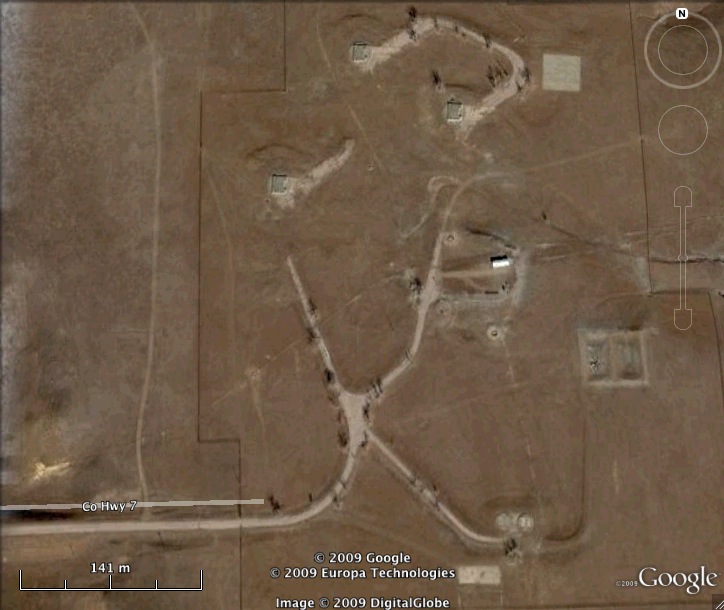
Titan I 850-B Missile Silo Ellsworth AFB South Dakota
Titan I 850-B
Squadron: 850th SMS
Date Activated: December 1st 1960
Date Deactivated: March 25th 1965
Air Force Base: Ellsworth
State: South Dakota
Nearest Town: Hermosa
Coordinates:
Latitude: 43°46'37.30"N
Longitude: 103° 8'48.12"W
Decimal:
Longitude: -103.1467
Latitude: 43 46.6216666666667
Longitude: -103 8.802
3 silos
Former Titan I Missile Complex with the 850th Strategic Missile Squadron
Read about the Titan I at Ellsworth AFB
List of all Titan I site Coordinates
Detailed information about the Titan I Intercontinental Ballistic Missile can be found here.


Overview
Titan I Missile Complex 850-B was the Hermosa member of Ellsworth Air Force Base's first intercontinental ballistic missile field. The three-complex deployment placed nine HGM-25A Titan I missiles in reinforced underground plants near New Underwood or Wicksville, Hermosa, and Sturgis. Each complex controlled three missiles. Site 850-B therefore represented one-third of the field's launcher force and one part of a larger network centered on Ellsworth for command, training, nuclear support, security, logistics, and maintenance.The Hermosa complex had a short missile career but a long second life tied to rural water. The Ellsworth Titan contract grew from an initial estimate of $47.2 million to $64 million by March 1962 after 265 modifications. Skilled labor shortages, high turnover, brief work stoppages, delayed equipment deliveries, and demanding acceptance procedures affected the three-site field. Complex 850-B cannot be assigned every field-wide problem, but it was built within that documented program and depended on the same design, contractor, and activation system.

The 850th Strategic Missile Squadron entered the national deterrent during rapid technological change. Ellsworth received nine operational Titan I missiles and had three crews ready on June 22, 1962. Four months later, the Cuban Missile Crisis placed the wing in an advanced state of readiness, and Ellsworth's Titan crews reportedly remained on heightened alert for 72 hours. Titan I was removed from alert on January 4, 1965, and the squadron was inactivated on March 25.
Federal records say Site 2 was conveyed to the Hermosa Water Users Association after deactivation and salvage. South Dakota drinking-water records provide an unusually specific surviving connection: East Well and West Well were built in 1959, are each listed as 1,800 feet deep and 8 inches in diameter, and remain emergency groundwater sources. A separate New West Well, built in 2004, is the permanent source. These records verify water-system use at the property, but they do not prove that missile silos, tunnels, the control center, or propellant rooms are used for water storage or treatment.
Installation Identity and Permanent Record
The permanent project identity is Titan I Missile Complex 850-B. The parent installation is Ellsworth Air Force Base. The remote launch complex was a distinct installation, even though its unit, support, and command relationships led back to Ellsworth.Official sources apply several names to the same complex. The detailed Department of Defense legacy study calls the locality Hermosa. The Corps of Engineers uses Ellsworth AFB Air Force Facility S2 and property number B08SD0344. Operational shorthand includes 850-B, Site B, Site 2, and Complex 1B. These names identify one three-launcher complex rather than separate installations.
The project point and the Corps FUDS point are less than one-tenth mile apart and identify the same general historic property east of Hermosa. The slight difference is normal for generalized historic-location records. Neither coordinate was published as a precise launcher, gate, property corner, road entrance, or current safe-access point.
Location, Water System, and Boundary Limits
South Dakota identifies the water system as PWS SD4602180 and gives its operating address as 23912 145th Avenue, Hermosa. The address is included for documentary reconciliation, not as an access instruction. The official system handbook lists East Well and West Well as 1959 construction, each 1,800 feet deep and 8 inches in diameter. Both are classified as emergency groundwater sources with no treatment at the well.The same state record lists New West Well as a permanent groundwater source built in 2004, 2,414 feet deep and 9 inches in diameter. Water from that source is treated at the system's treatment plant with hypochlorite disinfection. This later source distinguishes the active public-water system from the two older wells and prevents an unsupported claim that the association depends solely on missile-era infrastructure.
No official Custer County parcel polygon, legal description, original Air Force fee acreage, easement schedule, or current deed chain was verified in this pass. The history therefore does not publish a parcel boundary or acreage estimate. A visible surface compound, a FUDS point, a postal address, and a water-system facility are not interchangeable legal definitions.
The original military property may have included a fenced operating compound, fee tracts, access-road interests, utility corridors, communications routes, restrictive easements, and temporary construction areas. Later conveyances could have consolidated or divided those interests. Only recorded deeds, plats, easements, and a professional survey can establish the legal boundary.
Why Ellsworth Received Titan I
Strategic Air Command entered the intercontinental missile era while it still relied heavily on manned bombers. Ellsworth was already a major nuclear-capable bomber base with B-52 aircraft and a large support establishment. Existing runways, maintenance capacity, security, transportation, housing, communications, and nuclear-weapons infrastructure made the base a logical parent for a dispersed missile field.
Titan I was developed alongside Atlas as another path to a reliable operational ICBM. The two-stage missile provided greater range and payload than the earliest Atlas versions, but its operating concept still reflected the limitations of first-generation liquid-fueled systems. The missile remained below ground for protection, was loaded with liquid oxygen during a countdown, and was raised to the surface before launch. That sequence required a very large underground plant and exposed the missile during its final preparation.
Dispersal reduced the risk that one attack could eliminate the entire squadron. Ellsworth's nine Titans were divided among three widely separated complexes, each with three launchers, its own control center and power plant, and protected guidance equipment. If one complex were disabled, the other two could remain capable of receiving and executing an authenticated order.
The rural South Dakota setting provided open land and separation, but it also imposed operating costs. Construction materials, specialized workers, missile equipment, liquid oxygen, fuel-system parts, security teams, maintainers, inspectors, food, and ordinary supplies had to reach remote sites over local roads. Reliable power, water, sewage, ventilation, communications, and emergency systems had to be created at each underground complex rather than borrowed from an adjacent base.
Contract Award and Construction Management Leavell-Scott & Associates, a consortium of eight partners, received the contract for the three Ellsworth Titan I complexes on December 8, 1959. The detailed DoD Legacy study identifies New Underwood, Hermosa, and Sturgis as the project locations. The Omaha Engineer District initially provided Army Corps of Engineers oversight. About ten months into the job, responsibility transferred to the Corps of Engineers Ballistic Missile Construction Office, the specialized organization managing the national ballistic-missile construction program.

The contract began with an estimated value of $47.2 million. By March 1962, it had reached $64 million, a 31 percent increase attributed to 265 modifications. Some changes required contractors to demolish and replace completed work. The figures apply to the Ellsworth field as a whole and cannot be divided evenly among the three complexes, because geology, water, equipment, and corrective work differed by site.
The official synthesis describes a shortage of skilled labor. Workers were brought into the area, turnover was high, and the combined labor force at the three complexes reached about 2,500 at its peak. Labor-management relations were described as amicable. Fifteen work stoppages occurred, most lasting less than a day. A General Electric strike in October 1960 delayed delivery of terminals and affected the completion schedule.
Installing the propellant-loading system proved particularly expensive, as it did at other first-generation missile projects. The history also records a $500,000 groundwater-control problem at Complex 1C. That fact belongs to Site 850-C and is not reassigned to 850-B. Its importance here is comparative: even within one standardized field, local conditions could produce major cost differences.
Construction-Date and Contractor Conflict
A 44th Missile Wing unit-history compilation states that Titan I construction started in December 1960 and names Peter Kiewit and Sons as contractor. The more detailed official construction synthesis identifies Leavell-Scott's December 8, 1959 Titan contract and separately states that Peter Kiewit built the succeeding 150-site Minuteman field beginning in 1961. Because the detailed account distinguishes the two programs and cites the original Ellsworth Area Engineer history, Leavell-Scott controls the Titan contractor field in this history.December 1960 can still describe a major phase of visible construction or the chronology remembered by later unit histories. It should not replace the documented 1959 contract award. The record therefore uses a construction period of 1960 through 1962, preceded by the December 1959 award, rather than claiming an unsupported site-specific groundbreaking day.
This reconciliation matters because Titan and Minuteman construction overlapped. By the time Titan equipment was being installed and tested, Peter Kiewit's Minuteman workforce was excavating and building a far larger field. Later institutional memories could easily merge the two efforts. The correct approach is to preserve each source, explain the conflict, and avoid blending contractor identities.
Excavation and Underground Construction Titan I complexes were constructed by excavating enormous pits and shafts, building reinforced-concrete and structural-steel components, installing machinery and utilities, connecting the components with steel tunnels, and backfilling the completed plant. The finished landscape concealed most of the investment. Surface features included access and security works, launcher doors, guidance-antenna doors, ventilation structures, hatches, survey markers, utilities, roads, and drainage.

Standard Titan I engineering records describe three launcher silos placed on separate branches around the central plant. Each launcher branch included an equipment terminal and propellant terminal. The central group included the launch control center, powerhouse, entry portal, and two guidance antenna silos. More than 2,500 feet of corrugated-steel tunnel could connect the facilities, generally buried around 40 feet below the surface.
The launch control center contained command consoles, communications, authentication materials, status displays, crew work areas, and environmental systems. The powerhouse contained diesel generators and distribution equipment intended to keep the complex operating if commercial power failed. The entry portal, blast locks, and protected passages controlled access to the deeper plant.
Each missile stood on a large elevator. Titan I could not launch from underground. After receiving a valid order and completing preparation, the crew opened the launcher doors, raised the fueled missile, and launched from the surface.
Guidance, Communications, and Control
Titan I used an inertial system supplemented by radio guidance updates transmitted from the ground during early flight. Two retractable guidance antennas occupied protected silos within each complex. Redundancy helped preserve guidance capability if one antenna or its machinery failed. These were specialized missile-guidance antennas, not air-surveillance radar and not part of the Air Defense Command radar network.Communications tied 850-B to its crew positions, squadron command, Ellsworth support organizations, and national command channels. The exact routing and later modifications of every 850-B circuit were not found. Standard system records show that secure voice, order receipt, status reporting, timing, guidance, alarms, and internal communications formed one integrated network. A failure in power, environmental control, a launcher branch, or guidance equipment could affect readiness even if the missile itself was undamaged.
Command and control depended on authentication and two-person safeguards. Missile crews did not select targets independently. They maintained the site, verified status, responded to higher headquarters, and could act only through controlled procedures. The popular image of a single launch button obscures a complex chain of valid-message receipt, authentication, coordinated actions, system permissives, and physical equipment operation.
Missile, Propellants, and Launch Sequence
The HGM-25A Titan I was a two-stage liquid-propellant missile about 98 feet long. Both stages used RP-1 kerosene fuel and liquid oxygen. Liquid oxygen was cryogenic and could not simply remain aboard indefinitely. A real launch sequence therefore required loading the oxidizer, managing tanks and transfer equipment, controlling pressure and temperature, preparing the guidance system, opening doors, raising the missile, and firing from the surface.The propellant terminals housed equipment needed to move and control fuel and oxidizer. Equipment terminals supported elevators, doors, hydraulic machinery, and launcher services. Piping, valves, pumps, sensors, electrical systems, ventilation, alarms, and emergency procedures had to work together. The result was powerful but maintenance intensive.
Crews conducted recurring checks and propellant-loading exercises. These verified tanks, lines, pumps, valves, sensors, timing, communications, doors, elevators, and emergency responses without turning every exercise into an actual launch. The precise exercise schedule at 850-B was not located, so this history describes the standard duty rather than inventing dates.
Titan I's preparation time and exposed launch position were accepted as an interim capability. Titan II could remain fueled and launch from its silo. Minuteman used solid propellant and a smaller, simpler launch facility. Those advances explain why a field that cost $64 million and demanded years of work could be retired after less than three years of operational service.
Construction Security and Working Conditions
Security was strict even before the Air Force accepted the completed installations. The 44th Missile Wing history records that Wackenhut provided eight guards per shift. Positions included the gate, a jeep patrol on the surface, the control-center tunnel junction, each of the three launchers, and an antenna-silo position. The published wording accounts for the distribution as a field practice and is useful for understanding the controlled nature of construction access.Workers required badges. People entering below-ground areas signed in and surrendered smoking materials and other flame-producing items, receiving them back when they signed out. The rules reflected both classification and physical hazards. Construction sites contained fuel-system components, electrical work, heavy equipment, open shafts, lifting operations, welding, confined spaces, and newly installed machinery under test.
By February 1962, much of the equipment was installed and being tested. Hydraulic platforms that raised and lowered the missiles required repeated checks. Air Force Security Police assumed increasing responsibility as the sites moved from contractor control toward operational acceptance.
The surviving sources do not provide a complete 850-B worker roster, shift log, injury ledger, or day-by-day construction diary. They do show that the complex was not a single excavation project. It moved through structural construction, equipment installation, correction, integrated testing, security transition, crew training, missile delivery, and final operational readiness.
SATAF Acceptance and Technical Turnover
The Site Activation Task Force, or SATAF, represented the Air Force organization that tested, modified, and prepared newly constructed facilities before Strategic Air Command assumed operational responsibility. At Ellsworth, conflict arose because SATAF would not accept a site until nearly every item was functioning. Contractors sometimes had to maintain installed equipment for months while unresolved deficiencies were corrected.This distinction separates completion from readiness. A buried concrete plant could look finished while doors, elevators, generators, guidance electronics, communications, propellant systems, alarms, launch consoles, ventilation, or government-furnished equipment still failed tests. Each subsystem had to work alone and as part of an integrated weapon.
The June 22, 1962 milestone indicates that the 44th received nine operational Titan I missiles and had three crews ready for the mission. It does not prove that every individual acceptance document for 850-B was signed on that exact day.
The 850th Strategic Missile Squadron
The Air Force activated the 850th Strategic Missile Squadron on December 1, 1960, while construction continued. The squadron was initially associated with the 28th Bombardment Wing. The 44th Strategic Missile Wing was organized at Ellsworth on January 1, 1962 under the 821st Strategic Aerospace Division, and the 850th moved into the new wing structure.The 850th controlled maintenance and operations for the nine Titan I missiles. Site 850-B held three launchers and a complete crew station. Sister complexes 850-B and 850-C held the other six launchers. Squadron leadership, maintenance organizations, security forces, transportation, supply, training, and parent-base services linked the separated plants into one operational force.
The missile mission existed alongside Ellsworth's bomber work and the enormous Minuteman buildup. The 44th became the first Minuteman IB wing while still responsible for Titan I. Three Minuteman squadrons and 150 new launch facilities made Ellsworth's missile organization much larger, but Titan provided the immediate ICBM alert force during the transition.
Crew preparation required mastery of nuclear command and control, authentication, emergency actions, liquid-oxygen safety, electrical power, hydraulic equipment, doors, elevators, environmental control, communications, and security. Site-specific crew names and rosters were not located in accessible authoritative records. The history therefore keeps personnel discussion at the squadron and documented eyewitness level.
Operational Readiness and the Cuban Missile Crisis
An official Ellsworth history states that the wing received nine operational Titan I missiles on June 22, 1962 and had three crews ready to perform the mission and its associated tasks. This date anchors the field's operational entry more securely than later unsourced lists. It also shows how little time separated activation from the most dangerous nuclear confrontation of the era.In October 1962, the Cuban Missile Crisis placed Strategic Air Command in an advanced readiness posture. Ellsworth's Titan crews reportedly remained on alert for 72 hours. The source presents this as an Ellsworth field experience and does not identify a particular complex, crew, or launcher. It is therefore included as squadron context rather than claimed as an exclusive 850-B event.
No operational Titan I was launched from 850-B. Deterrence was the mission: a ready force had value because an adversary had to believe that the missiles could survive long enough to retaliate. Daily success meant maintaining the weapon, communications, power, guidance, crew competence, and command procedures without an accidental or unauthorized launch.
The Titan force occupied a narrow historical window. It was operational early enough to matter during the crisis and obsolete soon enough to disappear before many local residents fully understood its scale. Minuteman's dispersed single-silo system soon became the dominant visual and organizational form of Ellsworth's missile mission.
Ellsworth and Rushmore Support Network
Ellsworth Air Force Base provided the administrative and technical center for the remote complex. Personnel training, missile and vehicle maintenance, supply, transportation, security management, housing, medical services, communications support, and wing command functions remained at the parent base. The remote plant was self-contained for alert duty but not independent of that larger organization.Rushmore Air Force Station formed another important support link. Built just north of the airbase, Rushmore was a separate, highly secure nuclear-weapons storage and maintenance installation. Historic American Buildings Survey documentation says its administration and operation were largely independent and that it maintained its own housing, warehouse, and shop facilities until formal merger with Ellsworth in 1962.
Building 88247 at the former Rushmore station supported Titan I reentry-vehicle maintenance and training from 1962 to 1964. Extra warheads were stored in the weapons storage area while the launch complexes stood off base. The building was documented by HABS and was demolished after 2012.
The South Dakota Air and Space Museum now preserves an Ellsworth-associated Titan I missile. The artifact arrived from California in 1984, remained in storage for decades, received repairs in 2017, and was prepared for display. It is a legacy object rather than proof that a missile from 850-B survived.
Titan I and Minuteman Overlap
Ellsworth became a laboratory in generational change. While the Titan field was still under construction, work began on 150 Minuteman facilities. Titan used three huge multi-launcher complexes. Minuteman dispersed individual missiles across a much broader landscape and controlled groups of ten launch facilities from separate launch control centers.The difference in cost was striking. The nine Titan launchers cost about $64 million by March 1962. The 150 Minuteman facilities around Ellsworth cost about $75.7 million. The totals do not include every lifecycle expense and should not be treated as a modern purchasing comparison, but they show the construction advantage of smaller standardized facilities and a mature management system.
Minuteman construction also helps explain source confusion. Peter Kiewit and Sons employed thousands of workers across the South Dakota field while Titan activation continued. By April 1963, the first Minuteman missile was emplaced. By October, the wing controlled a fully operational 150-missile force. Titan remained on alert for a time, but its strategic importance was rapidly overtaken.
Site 850-B did not become a Minuteman launch facility. The systems had different layouts, command arrangements, and property requirements. The former Titan plant entered disposal and reuse, while Minuteman continued at Ellsworth until the early 1990s.
Phaseout and Deactivation
On May 16, 1964, Secretary of Defense Robert McNamara directed an accelerated phaseout of Titan I and Atlas missiles. The decision reflected the advantages of Titan II and Minuteman, including faster launch preparation, simpler operation, reduced dependence on cryogenic oxidizer loading, and improved survivability.The 850th's missiles were removed from alert on January 4, 1965. This is the best supported date for the end of operational readiness. Deactivation required more than turning off consoles. Warheads and missiles had to be removed, classified materials controlled, propellants and hazardous systems addressed, equipment dispositioned, utilities changed, and the property prepared for federal excess and salvage.
The Air Force inactivated the 850th Strategic Missile Squadron on March 25, 1965. The two dates should remain separate. January 4 marks alert withdrawal; March 25 marks organizational inactivation.
The complex's military career had lasted less than three years from the June 1962 field readiness milestone. Its brief service was not evidence that it failed to matter. Titan I provided an operational bridge from early ICBM experimentation to a much larger and more durable solid-fueled force.
Federal Excess, Salvage, and Conveyance
Current Corps of Engineers FUDS data say Site 2 was deactivated with the Ellsworth Titan field and later conveyed to the Hermosa Water Users Association. The public feature description associates the transfer with continuous water-system use and the deep wells on the site. That federal summary establishes the broad succession from Air Force launch complex to water property, but it does not supply the complete deed chain or every intermediate disposal date.Salvage at a Titan I site could remove machinery, steel, electrical equipment, wiring, piping, doors, reusable components, and other material with resale value. Removal altered the relationship among structural supports, openings, floors, and barriers. A plant described as intact in an older historical survey may still have extensive internal damage or missing systems.
The reviewed public record did not yield a site-specific salvage contract, inventory of removed equipment, original quitclaim deed, transfer acreage, or current title report.
The Corps record uses private-public-health-services wording for the owner category while South Dakota classifies the Hermosa Water Users Association as local government. These descriptions come from different databases and periods. The current state classification controls the description of the operating public-water system, while the Corps record remains evidence for FUDS identity and historic conveyance.
Formerly Used Defense Sites Environmental Record
The U.S. Army Corps of Engineers identifies the former complex as eligible FUDS property B08SD0344, Ellsworth AFB Air Force Facility S2, with installation identifier SD89799F078000. The fiscal year 2024 record says the property has projects, is not on the National Priorities List, and is a property with all projects at site closeout.The published South Dakota FUDS inventory lists property-level site 00 in the hazardous, toxic, or radioactive waste category and project 01 in the containerized hazardous, toxic, or radioactive waste category. A Department of Defense fiscal year 2023 final-response-complete table lists two Installation Restoration Program sites, no Military Munitions Response Program sites, and $59,000 in recorded costs through fiscal year 2023.
Those program labels prove that environmental work was tracked and reached the reported response milestone. They do not identify every contaminant, sample result, removal volume, institutional control, or present subsurface condition. They also do not show that the missile plant's structural hazards were evaluated as part of the environmental response.
Project closeout and final response complete are environmental-program statuses. This status is not a warranty that an abandoned underground missile facility is safe. FUDS addresses eligible former Department of Defense contamination. It does not certify structural soundness, remove hazards created after federal ownership, establish public access, or replace confined-space and property-law restrictions.
The located public sources did not provide a complete site-specific decision document or sampling appendix for B08SD0344. The history reports verified program categories and status without inventing contaminants. Fuel-system residues, industrial fluids, electrical materials, salvage debris, standing water, and structural deterioration are plausible concerns at former missile complexes, but plausibility is not a substitute for site-specific analytical evidence.
Current Ownership and Water-System Use
South Dakota identifies Hermosa Water Users Association as a local-government groundwater public-water system serving residential areas in Custer County. The April 12, 2024 system handbook reports 108 people and 49 service connections. The 2025 consumer confidence report describes more than 108 customers and average use of approximately 175,000 gallons per day. These figures belong to the water system, not to the historic missile population or acreage.East Well and West Well are the most important documented physical link between the missile-era property and current public use. Both are dated 1959, the year the Ellsworth Titan construction contract was awarded. Their listed depth and diameter are identical. Their present classification is emergency groundwater, while the 2004 New West Well is permanent. The timing and location strongly associate the older wells with initial site development, but the water records do not explicitly call them Air Force construction wells.

The Corps states that Site 2 was conveyed to the Hermosa Water Users Association and that the deep on-site wells were used for the rural water system. This supports a continuity of water-related use without proving that any underground missile chamber was converted to water storage, treatment, or pumping. The state identifies a treatment plant and a modern permanent well as separate facilities.
Drinking-water compliance and former-defense-site cleanup answer different questions. Water monitoring concerns the quality delivered to customers. FUDS status concerns eligible defense-related environmental response. Structural safety concerns deep shafts, tunnels, rooms, doors, and equipment supports. A favorable or completed record in one category should not be used as proof in another.
The current water-system identity does not create a public right of entry. Operational wells, treatment equipment, controls, power systems, and former military structures can all require restricted access. The history supplies documentary coordinates for geographic context only.
Surviving Features and Condition Limits
The DoD Legacy study said the Hermosa complex was in private ownership, had been salvaged, and retained its main structure at the time of the survey. A 2001 missileers' association visit described 850-B and 850-C as being in reasonably good condition. Both observations are historically useful but time limited and nonengineering in character.Official state water records demonstrate that two 1959 deep wells still exist as listed emergency sources. They do not inventory launcher doors, guidance antenna doors, the entry portal, ventilation structures, control-center levels, powerhouse equipment, tunnels, or individual silos. The presence of one surviving infrastructure class cannot establish the condition of the remainder.
No current professional structural inspection, interior photographic survey, or public historic-access program was located. Silos may be capped, flooded, modified, partly filled, or obstructed. Tunnels and rooms may contain water, debris, corrosion, altered ventilation, or damaged structural elements. The exact underground configuration in 2026 remains unverified.
The property should be treated as a controlled former military and active water-system location. Coordinates and graphics are provided to explain history, not to guide exploration. Entry without permission may be trespass, and confined underground spaces can be lethal even when they appear stable.
Public Access and Safety
No public access is established. The associated organization operates a public-water system, not a museum or historic-tour facility. Readers should not enter, cross barriers, open covers, disturb equipment, approach wells, or interfere with treatment and distribution facilities without explicit authorization.Former missile complexes contain hazards that may not be visible from the surface. Deep shafts, deteriorated stairs, unsecured openings, standing water, oxygen-deficient spaces, electrical remnants, sharp salvage edges, unstable platforms, animals, and contaminated media may exist. A former military designation does not make property abandoned in a legal or practical sense.
The South Dakota Air and Space Museum provides a lawful way to encounter Ellsworth's Titan legacy through a preserved missile artifact. Historic American Engineering Record documents and official Air Force photographs offer safe access to the engineering and institutional story. These alternatives are preferable to unauthorized site entry.
Site Layout
The site-layout graphic accompanying this history is based on documented standard Titan I engineering. It shows the relative functional arrangement of three launchers, equipment terminals, propellant terminals, control center, powerhouse, entry portal, guidance antenna silos, and tunnels. It is not a surveyed plan of 850-B and does not claim site-specific dimensions or present condition.
The location graphic marks the project representative point and the Corps FUDS point against a generalized Hermosa-area context. Because an official current parcel polygon was not verified, it does not draw a property boundary. It also omits precise launcher centers, gates, wells, and access routes.
Chronology
- 1952 Rushmore Air Force Station is completed north of the Rapid City airbase as an independent nuclear-weapons storage and maintenance installation.
- 1953-06-13 Rapid City Air Force Base is dedicated as Ellsworth Air Force Base.
- 1957 B-52 operations and a mature strategic-bomber support system strengthen Ellsworth's role as a nuclear installation.
- 1959 South Dakota drinking-water records date Hermosa Water Users Association East Well and West Well to this year. Each is 1,800 feet deep and 8 inches in diameter; both are currently classified as emergency sources.
- 1959-12-08 Leavell-Scott & Associates receives the contract to build the three Ellsworth Titan I complexes near New Underwood, Hermosa, and Sturgis.
- 1960 Major field construction proceeds under Omaha Engineer District oversight.
- 1960-10 Responsibility transfers to the Corps of Engineers Ballistic Missile Construction Office about ten months into the project. A General Electric strike delays terminal deliveries.
- 1960-12-01 The 850th Strategic Missile Squadron activates while construction continues.
- 1961 Equipment installation, correction, integrated testing, and acceptance work continue at the Ellsworth complexes.
- 1961-08-21 Construction begins on Ellsworth's succeeding Minuteman field, overlapping Titan completion.
- 1961-09 Later unit history reports that major Titan structures were built and buried, with substantial interior work still incomplete.
- 1962-01-01 The 44th Strategic Missile Wing is organized at Ellsworth under the 821st Strategic Aerospace Division.
- 1962-02 Much equipment is installed and under operability testing, including hydraulic missile platforms.
- 1962-03 The Ellsworth Titan construction total reaches about $64 million after 265 contract modifications.
- 1962 Rushmore Air Force Station is formally merged with Ellsworth. Building 88247 begins Titan I reentry-vehicle maintenance and training support.
- 1962-06-22 The 44th receives nine operational Titan I missiles and has three crews ready for the mission.
- 1962-10 The Cuban Missile Crisis places the wing in an advanced state of readiness. Ellsworth Titan crews reportedly remain on alert for 72 hours.
- 1963-04 The first Ellsworth Minuteman missile is emplaced, beginning operational replacement of the much smaller Titan force.
- 1963-10 Ellsworth's 150-missile Minuteman field reaches full operational status.
- 1964-05-16 Secretary of Defense Robert McNamara directs accelerated phaseout of Titan I and Atlas ICBMs.
- 1965-01-04 The 850th's Titan I missiles are removed from alert status.
- 1965-03-25 The 850th Strategic Missile Squadron is inactivated.
- After deactivation and salvage The Corps of Engineers records Site 2 as conveyed to the Hermosa Water Users Association for continuing rural-water use of the deep on-site wells. The precise deed date was not located.
- 2001 A visiting missileers' association describes 850-B and 850-C as being in reasonably good condition. This is an observational period statement, not a current structural assessment.
- 2004 Hermosa Water Users Association completes the 2,414-foot New West Well, now listed as its permanent groundwater source.
- 2015-09-30 The published South Dakota FUDS inventory lists B08SD0344 with HTRW and containerized HTRW records.
- Before fiscal year 2023 The Department of Defense records final response complete for the property, with two Installation Restoration Program sites and no Military Munitions Response Program sites.
- 2024-04-12 South Dakota's system handbook lists 108 people, 49 service connections, two 1959 emergency wells, the 2004 permanent well, and hypochlorite treatment.
- 2024 USACE FUDS data list B08SD0344 as eligible, not on the NPL, and a property with all projects at site closeout.
- 2025 The consumer confidence report describes a groundwater system serving more than 108 customers and using an average of approximately 175,000 gallons per day.
- 2026 The former launch complex remains associated with an active public-water system, while exact parcel boundaries and underground structural condition remain unverified.


Sources & References
- PDF To Defend and Deter: The Legacy of the United States Cold War Missile Program SOURCE FOR: Titan I engineering; Ellsworth contract award, contractor, cost, modifications, labor, delays, acceptance problems, 850th chronology, alert withdrawal, inactivation, historic ownership, salvage, and condition context.
- PDF 44 Missile Wing Unit History SOURCE FOR: 44th Strategic Missile Wing organization, Titan I assignment, construction security practices, equipment testing, June 22, 1962 missile receipt, 850th operational control, site localities, and Cuban Missile Crisis readiness.
- WEB Titan I Missiles Put Ellsworth on Nuclear Map SOURCE FOR: Official Ellsworth narrative, Hermosa naming, nine-missile and three-crew readiness, 72-hour Cuban Missile Crisis alert, and operational significance.
- PDF Ellsworth Air Force Base History and Base Guide SOURCE FOR: 850th activation context, Ellsworth bomber and missile chronology, Titan arrival, and transition to Minuteman.
- PDF Ellsworth Air Force Base, Rushmore Air Force Station, Oil Pump Station, HABS SD-21-R SOURCE FOR: Rushmore's separate administration, merger with Ellsworth in 1962, Ellsworth strategic context, three Titan complexes, 1962 operation, and 1965 deactivation.
- WEB Ellsworth Air Force Base, Type S Structure, Building 88247, HABS SD-21-AF SOURCE FOR: Rushmore nuclear-weapons mission, extra Titan warhead storage, Titan reentry-vehicle maintenance and training from 1962 through 1964, and later demolition.
- PDF Titan I Missile Complex 2A, HAER CO-89 SOURCE FOR: Representative standard Titan I complex engineering, component functions, guidance antennas, tunnels, launch sequence, and measured design context. It is not used as a site-specific 850-B survey.
- WEB Titan I Intercontinental Ballistic Missile SOURCE FOR: National Park Service overview of Titan I development, liquid propellants, underground storage, surface launch, guidance, and operational transition.
- PDF Ballistic Missiles in the United States Air Force, 1945-1960 SOURCE FOR: Official Air Force development history, strategic requirements, Titan program context, and early ICBM deployment.
- WEB FUDS Property B08SD0344, Ellsworth AFB Air Force Facility S2 SOURCE FOR: Federal property identity, eligibility, non-NPL status, fiscal year 2024 project-closeout status, ownership category, conveyance to Hermosa Water Users Association, and Corps coordinate.
- PDF Formerly Used Defense Sites Per State, South Dakota SOURCE FOR: Published inventory entries for B08SD0344, property-level HTRW, and project 01 containerized HTRW.
- PDF Status of Active Installations, BRAC Locations, and FUDS Properties Achieving Final Response Complete Before Fiscal Year 2023 SOURCE FOR: Final-response-complete status, two Installation Restoration Program sites, no Military Munitions Response Program sites, and reported costs through fiscal year 2023.
- PDF Hermosa Water Users Association Public Water System Handbook SOURCE FOR: PWS SD4602180, local-government classification, population and connection figures, well names, construction dates, depths, diameters, availability, groundwater type, and treatment.
- PDF Hermosa Water Users Association 2025 Drinking Water Report SOURCE FOR: Current groundwater-system operation, customer estimate, average daily use, treatment, source assessment, and drinking-water reporting context.
- PDF Titan I Missileers Newsletter, June 2001 SOURCE FOR: Period observation that visiting association members viewed 850-B and 850-C as being in reasonably good condition. It is not used as a current engineering assessment.
- WEB A Titan Laid to Rest SOURCE FOR: Official Air Force account of the preserved Ellsworth-associated Titan I missile, its 1984 arrival, storage history, 2017 move, and museum display role.